
On top of Mount Tabor is a Greek Orthodox Monastery- St. Elias.
Home > Sites > Yizreel Valley> Mount Tabor > Greek Orthodox Monastery
Contents:
Background
Aerial Map
History
Photos
* Access road
* Entrance
* Exterior
* Interior
* Aerial views
* Nature
Biblical
Links
Background:
On the north-east side of the top of Mount tabor is a Greek-Orthodox monastery, St. Elias, named after Elijah the prophet. Matthew 17 1-2: “…there appeared unto them Moses and Elias talking with him”
For more information on Mount Tabor and its sites, see the overview page.
Aerial Map:
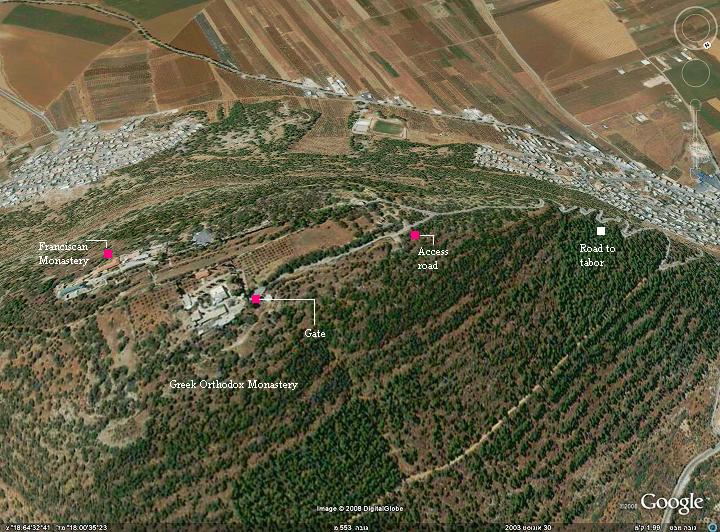
The following aerial view shows the points of interest around the monastery, which is located on the north-east side of the top of the hill.
History:
The monastery was built in 1911, over the ruins of earlier churches.
The Monastery is closed to the public.
Photos:
(a) Road access to the Monastery:
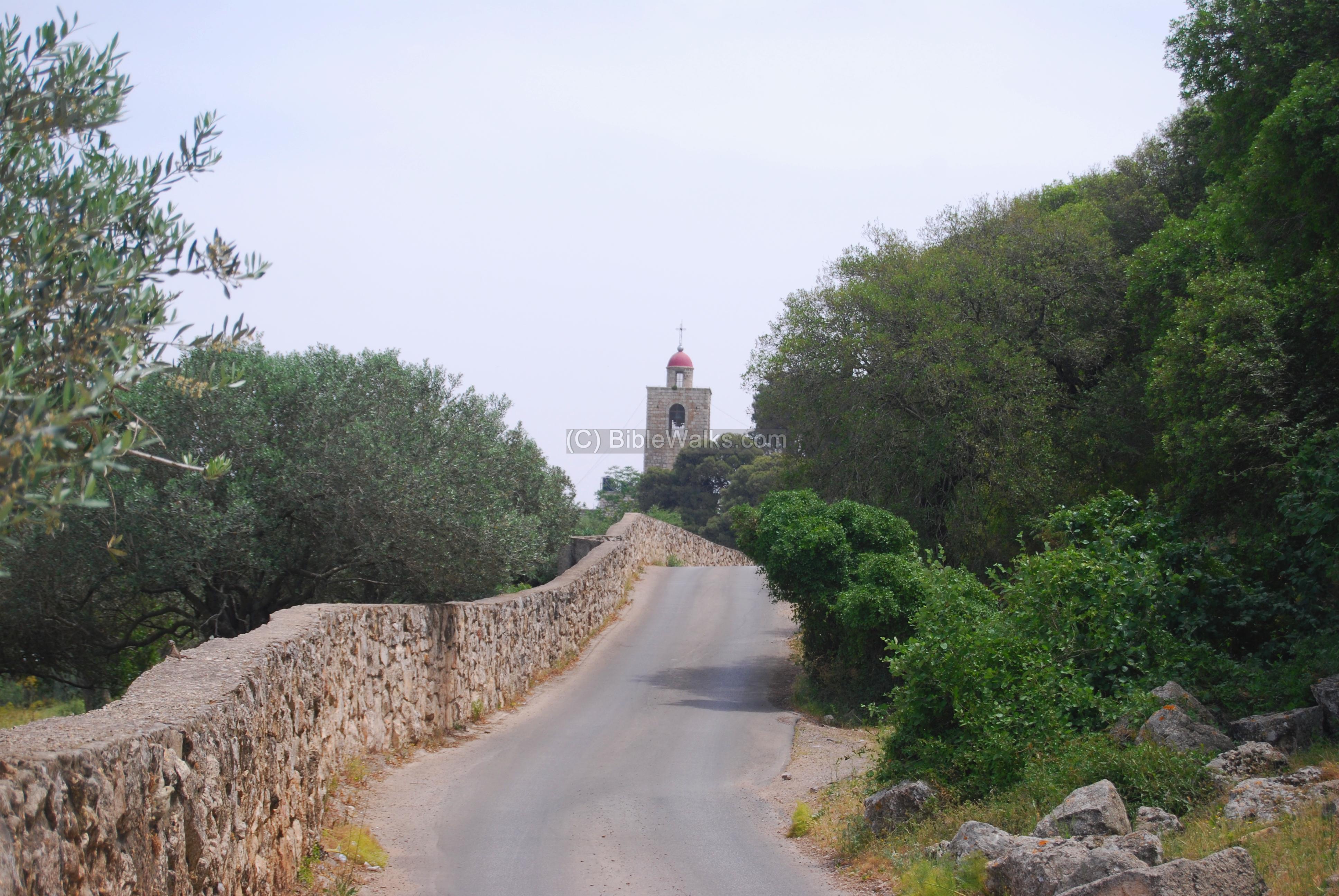
At the top the Tabor the road splits to the Franciscan Monastery and to the Greek Monastery. The north fork of this access road leads to the Greek complex.
The photo below shows the access road and the tower of the Greek Monastery in the center background. On the left (north) side of the road is a stone fence, while on its right side are bushes , trees and traces of ruins.
Click on the photos to view in higher resolution…
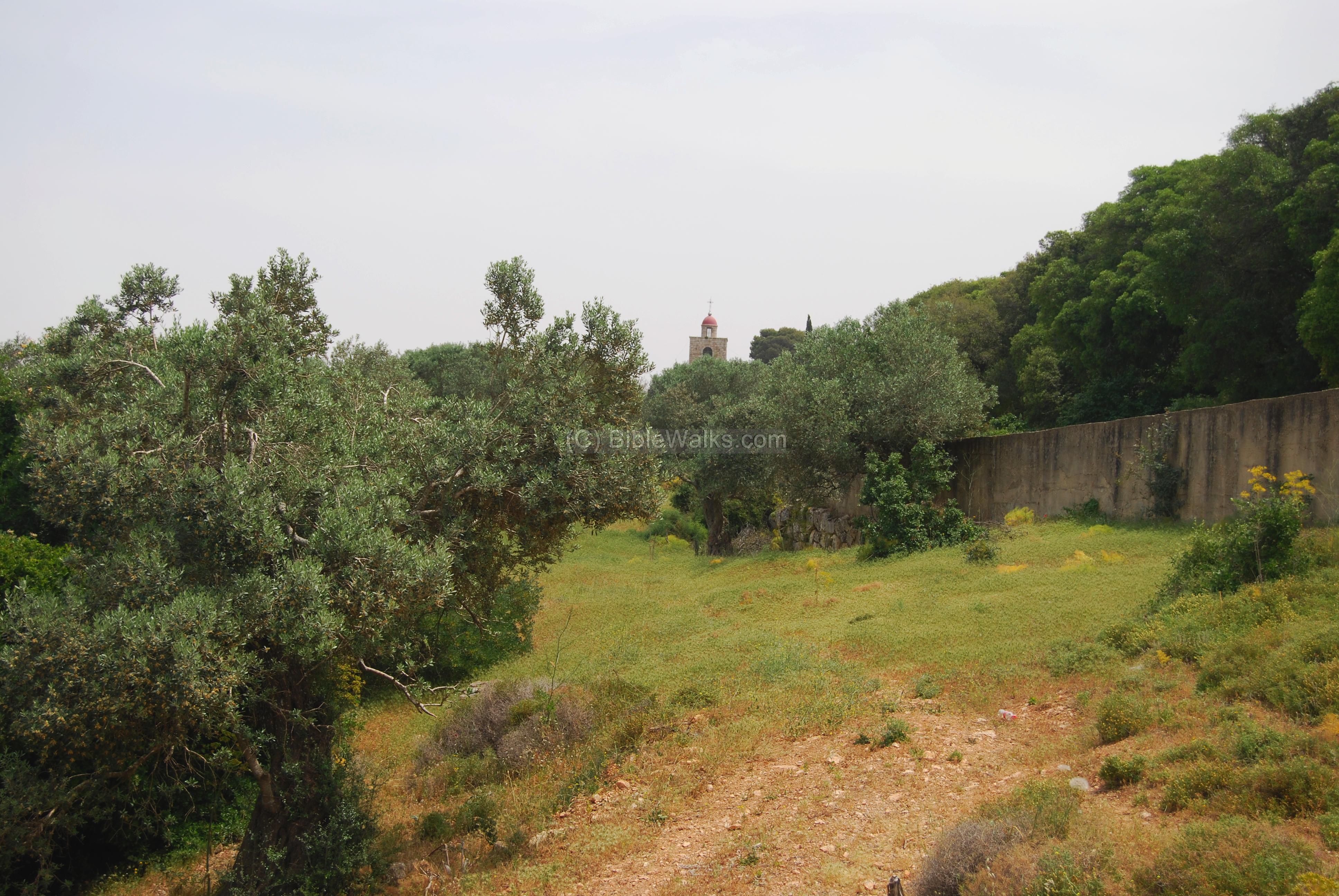
The north side of the access road is a steep descend down to the valley, which is covered with olive trees and grass.
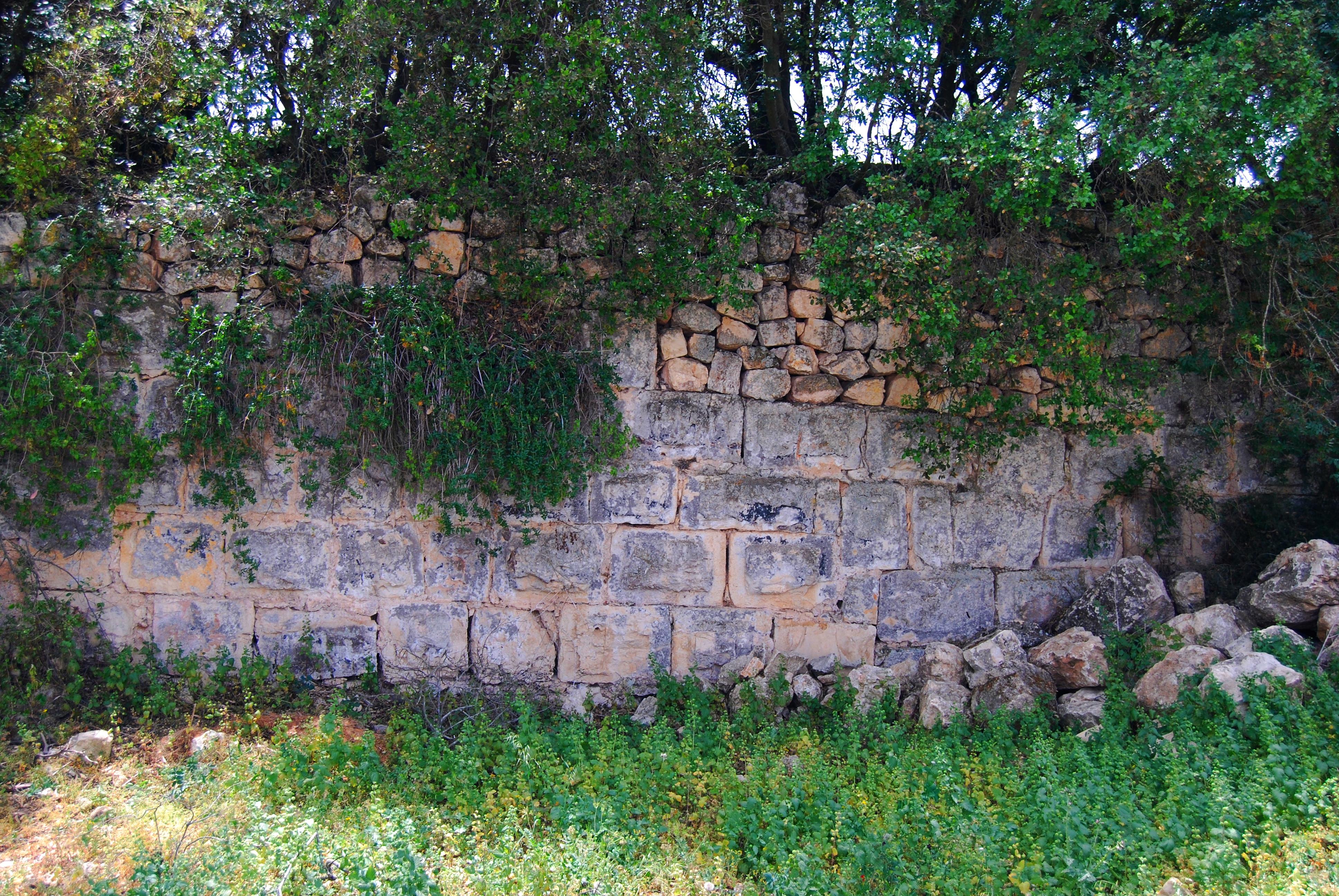
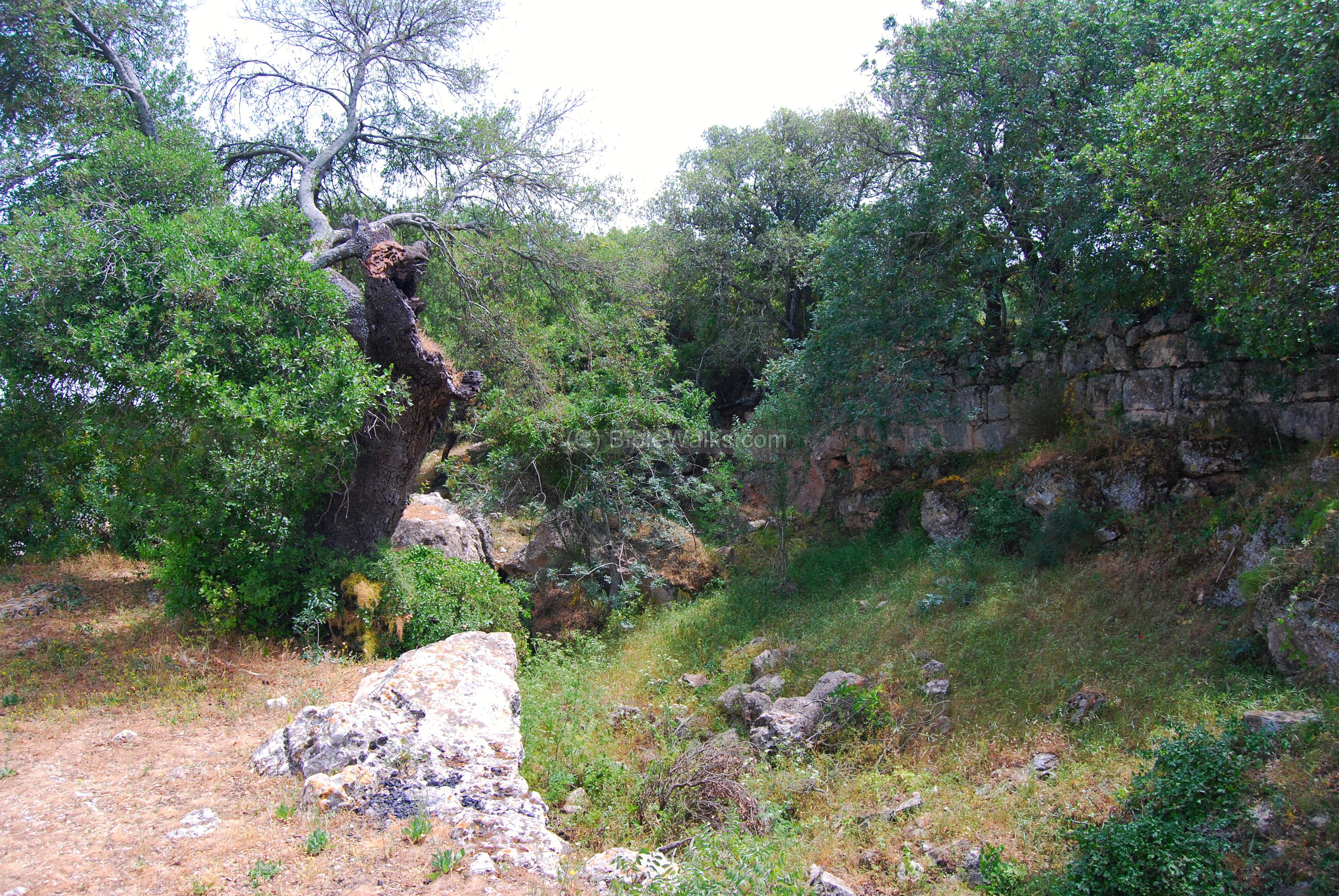
Along the south side of the access road stretches a wall which is based partly on Crusader stones (large, nicely cut). On top of them are later period stones (smaller, coarse cut). These larger stones were dismantled from the churches and Crusaders structures, and were reused to build a massive fortress in 1212-1213 by the Sultans of the Ayoubi state as a defense against the Crusaders.
In some parts along the road are deeper sections of the defense moat, such as seen below.
(b) Entrance to the Monastery:
After arriving to a wide parking lot, the bell tower is seen above the gated entrance.

A closer view of the entrance door is seen below. The symbol on the gate and above the door is “TΦ” (Tau + Phi) meaning ‘taphos‘ or ‘Sepulchre’ – the Holy Sepulcher. This is the symbol of the Greek Orthodox church.
The date below the symbol shows the year of the construction – 1911.

The sign above the door reads the “Greek Orthodox Patriarchate of Jerusalem – Abbey of the Savior’s Mount of metamorphosis”.
Note that “metamorphosis” is transfiguration in Greek.
(c) Church exterior:
The photo below shows a view of the Church at St. Elias, as seen from the Franciscan Monastery.

(d) Church Interior:
The monastery is closed to the public, but we hope that we can visit it in the future.
(f) Aerial Views:
 The following YouTube video shows a flight over the monastery:
(e) Nature:
Along the walls and fields, among other plants and flowers, grow a sort of nasty “nettle” plants. The local type is called Sirpad (Roman Nettle – “urtica pilulifera“), which grow small green balls that cause severe stinging and rash. It is named after the Romans since their troops used it for medical purposes and propagated it throughout the empire, planting it near their camps.
Each of the dozens of balls that grow on such plant has hidden sharp poisonous needles. It is advised to wear long pants and closed shoes while walking off the hiking trails, and avoid being pricked by these stinging balls and leaves.
The sirpad (Roman nettle) can be found in the several Biblical texts:
(a) Isaiah: In the Hebrew text it appears as “sirpad”, and in the KJV version it appears as “brier” which means a thorn. Isaiah 55: 13: “Instead of the thorn shall come up the fir tree, and instead of the brier shall come up the myrtle tree”.
(b) Job: In the Hebrew text it is called “charul” and in KJV it is “nettle”. Job 30, 7: “Among the bushes they brayed; under the nettles they were gathered together”.
Biblical References:
Matthew 17
According to Matthew 17:1-13 (and Mk 9:2, Lk 9:28), Jesus is transfigured before Peter, James, and John on the “mountain“. There are several candidates, such as Hermon (the tallest in Israel) and Tabor. Both are also referred as high mountains, see Psalms above (“Tabor and Hermon shall rejoice in thy name“). Tabor is closer to the center of Jesus activities, and also it is referred as “the mountain” in other texts. According to old traditions, Tabor is the holy mountain, and is called “the mount of Transfiguration” .
“And after six days Jesus taketh Peter, James, and John his brother, and bringeth them up into an high mountain apart, And was transfigured before them: and his face did shine as the sun, and his raiment was white as the light.
And, behold, there appeared unto them Moses and Elias talking with him. Then answered Peter, and said unto Jesus, Lord, it is good for us to be here: if thou wilt, let us make here three tabernacles; one for thee, and one for Moses, and one for Elias. While he yet spake, behold, a bright cloud overshadowed them: and behold a voice out of the cloud, which said, This is my beloved Son, in whom I am well pleased; hear ye him. And when the disciples heard it, they fell on their face, and were sore afraid. And Jesus came and touched them, and said, Arise, and be not afraid.
And when they had lifted up their eyes, they saw no man, save Jesus only. And as they came down from the mountain, Jesus charged them, saying, Tell the vision to no man, until the Son of man be risen again from the dead.
And his disciples asked him, saying, Why then say the scribes that Elias must first come? And Jesus answered and said unto them, Elias truly shall first come, and restore all things. But I say unto you, That Elias is come already, and they knew him not, but have done unto him whatsoever they listed. Likewise shall also the Son of man suffer of them.
Then the disciples understood that he spake unto them of John the Baptist”.
Links:
External Links:
Internal links:
- Mount Tabor – overview
- Franciscan Monastery, Tabor
- Other Tabor sites
- Check out our new pictorial presentation of the footsteps of Jesus.
The transfiguration is event #68.

BibleWalks.com – walk with us through the sites of the Holy Land
Tabor (Franciscan) <<–previous site—<<< All Sites>>>–-next Yizreel Valley site –>>> Tabor (structures)
This page was last updated on Feb 10, 2018 (Added Aerial view)
Sponsored links: