
One of the most holiest churches, located in Jerusalem at the traditional site of Golgotha – the place of Jesus Crucifixion and burial.
Home > Sites > Jerusalem > Church of Holy Sepulchre (Sepulcher)
Contents:
Overview
History
Location
Structure
Photos
* General view
* Entrance
* Anointing stone
* Catholicon
* Armenian
* Rotunda
* Angel Chapel
* Jesus Tomb
* Coptic chapel
* Jacobite chapel
* Magdalene
* Prison of Jesus
* St Longinus
* Holy Robes
* St Helen
* Finding cross
* Derision
* Chapel of Adam
* Calvary
* Nails of Cross
Biblical
Etymology
Links
Overview:
The Church of the Holy Sepulchre is one of the most Holy sites in the Christian world. It is a major Christian pilgrimage site located in the Old City of Jerusalem. It is believed to be the site where Jesus Christ was crucified, buried, and resurrected. The church is also known as the Church of the Resurrection by Eastern Orthodox Christians.
The 12th century structure is located on the traditional site of Golgotha. Matthew 27: 33, 60: “And when they were come unto a place called Golgotha….And laid it in his own new tomb, which he had hewn out in the rock: and he rolled a great stone to the door of the sepulchre, and departed”
The Church of the Holy Sepulchre is a complex building that includes several chapels, each with its own religious significance. The most important of these chapels is the Tomb of Christ, which is believed to be the site where Jesus was buried and resurrected. The church also contains the Stone of Unction, where Jesus’ body was anointed before his burial, and the Chapel of the Finding of the Cross, where the True Cross was discovered by Saint Helena, the mother of Constantine.
The site has seen many historical events and religious conflicts over the centuries. Today, it is shared by several Christian denominations, including the Greek Orthodox, Roman Catholic, and Armenian Apostolic churches. The church is a symbol of Jerusalem’s long and complex history, and it continues to attract pilgrims and visitors from around the world.
History:
- Constantine’s Basilica (4th-7th century )
The Church was established in 333 AD by the Roman emperor Constantine , who had converted to Christianity. This was after his mother, Queen Helena, marked the place of Golgotha during her visit in 326 AD. The site was selected based on memories of the site as an execution place, and on the existence of a garden, tombs and fragments of wood planks.
This basilica is illustrated in the Byzantine mosaic map of Madaba, which was discovered in 1884 in a Byzantine church in Madaba, Jordan. This ancient map, laid out in the 6th century AD, shows the map of the Holy Land, with dozens of illustrated sites, including Jerusalem and the original basilica that once stood there. It has three doors on the front, parts of one of them survived in the current structure.
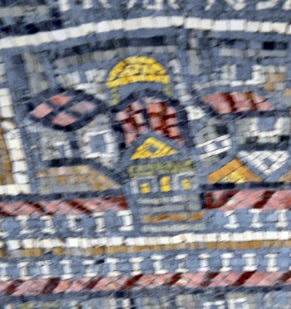
Madaba map: Constantine’s basilica
The large basilica was leveled by the Persian intrusion (614 AD). The new church was built on top of it, so few remains of the foundation are left.
- Restored Basilica (7th-11th century )
After the conquest of Jerusalem by the Arabs (638 AD), the basilica was partially restored on a smaller scale. It was initially honored by the new rulers, who respected Jesus and his burial place. However, it was again leveled in 1009 AD by the Arab rulers when their faith became more extreme. This destruction may have sparked the Crusaders waves of conquest, which aimed at regaining the control of the Holy city and rebuilding the church.
- Crusaders (11-12th century )
In 1099 AD the Crusaders take the city and hold it until 1187. They restored the basilica and inaugurated it in 1149 AD as St. Sepulchre. After the surrender and fall of the city to the Saladin army, the Arabs honored the church, and the key to the church was kept by Arab families – until this date.
The third Crusaders campaign (1189-1192) attempted to recapture the Holy city and regain control of the church, but failed. However, a treaty between Richard and Saladin (1192-1195) allowed pilgrims to visit the church. Five more Crusades (1204-1270) also failed to regain the city.
-
Modern times
In July 1927 the church suffered damages in the 6.3 magnitude earthquake.
The church is controlled by different Christian denominations within the church, each having a part of it: Catholics, Armenian, Greek Orthodox, Syrian Orthodox, Coptic and Ethiopian. The Muslim families have the key to the main door since 1187, and used to sit in the entrance, manage the church, and mediate between the different denominations. It is opened to the public and attracts hundreds of thousands of visitors year round.
Structure:
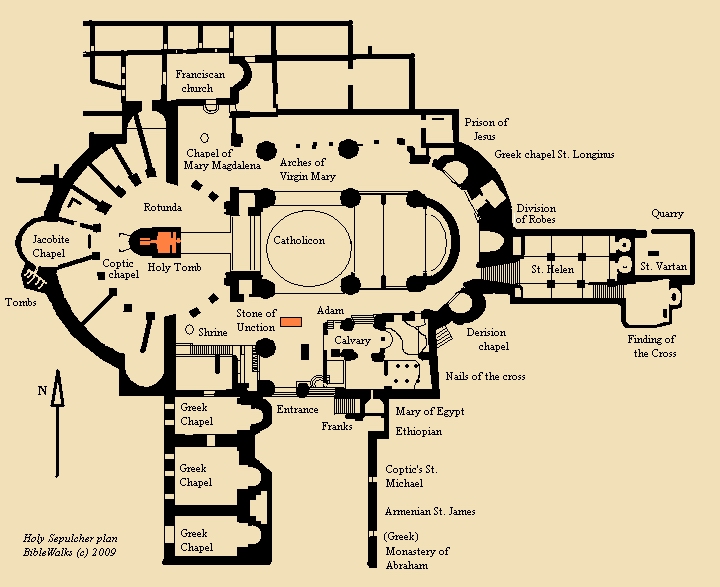
A floor plan of the church is seen below. The Holy Sepulchre (tomb, marked in orange) is located in the center of the Rotunda hall, under the larger dome. Inside the church are many altars and points of interest; they are detailed in the sections below, with smaller maps that pinpoint the specific location inside the church.
Photos:
The photos below follow a clock wise tour of the church, starting from the entrance on the south side.
(a) General view:
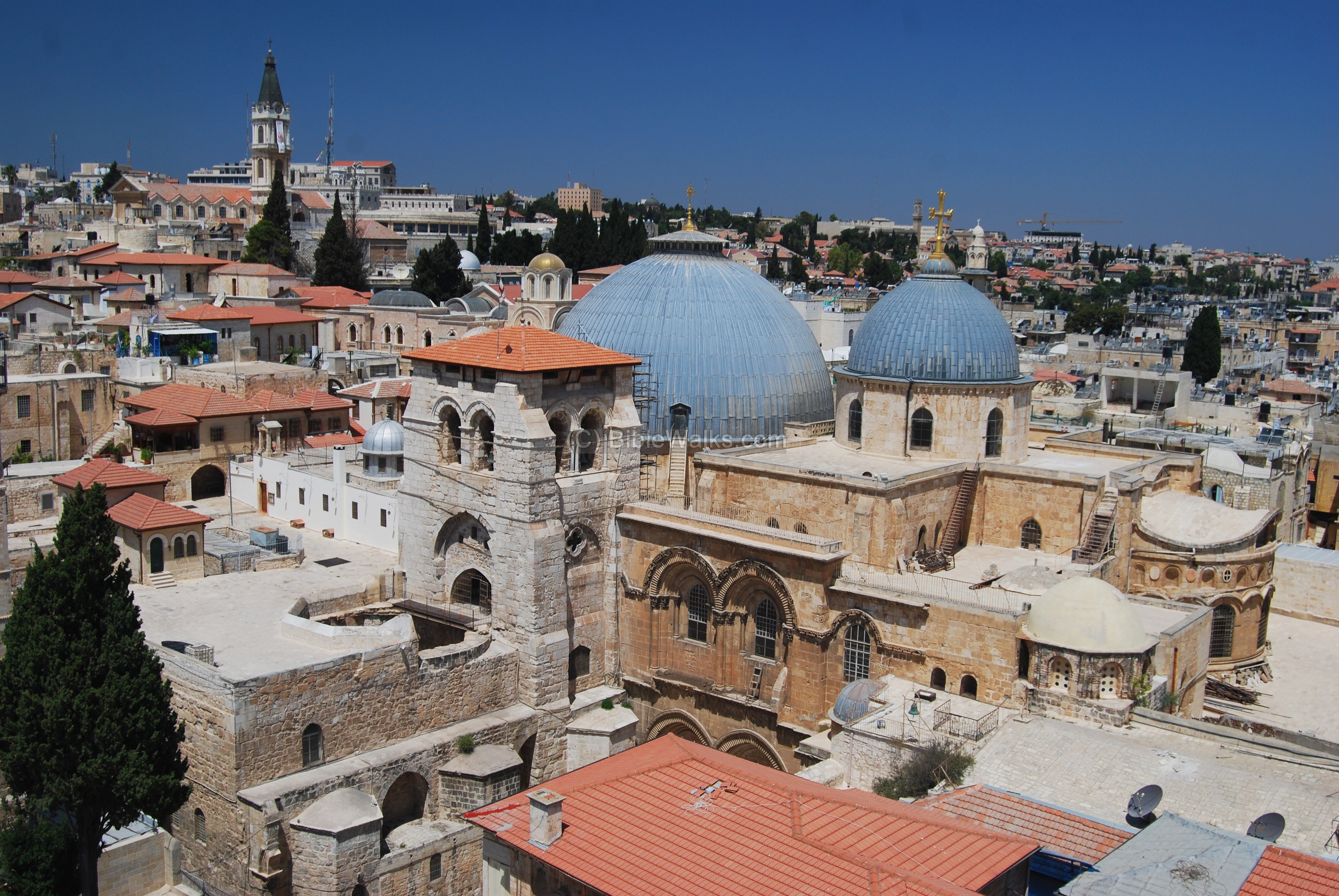
A general view of the structure is seen from the bell tower of the Redeemer church, on the east side of the Holy Sepulcher. The larger dome is located over the Rotunda, the round hall where the tomb of Jesus is located. The smaller dome on its right is located over the Catholicon hall.
Click on the photos to view in higher resolution…
(b) Yard and entrance:
| The church of the Holy Sepulcher, the site of the crucifixion and burial site of Jesus, can be approached from the St. Helena alley in the Christian quarter, through a gate, as seen on the right side. | 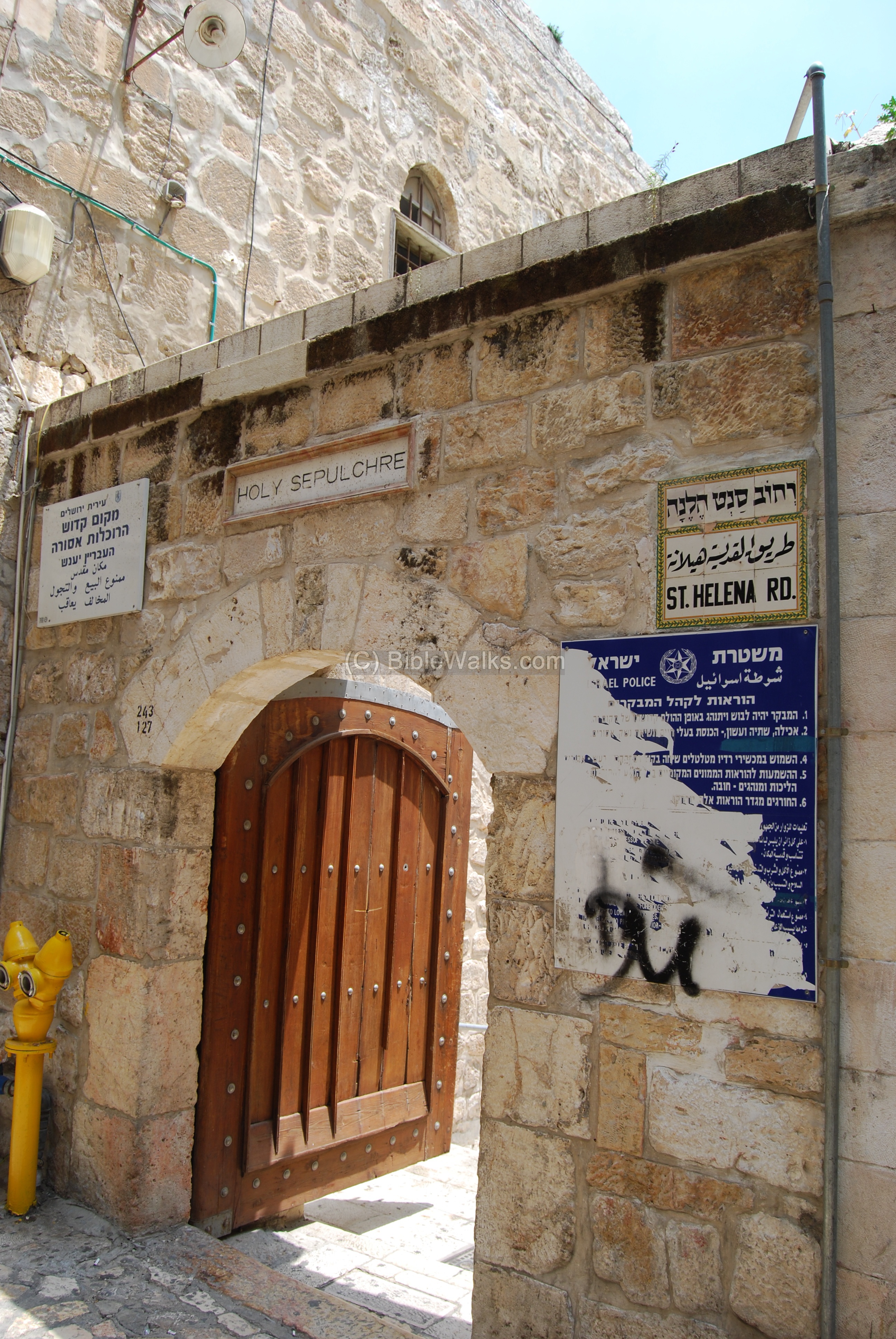 |
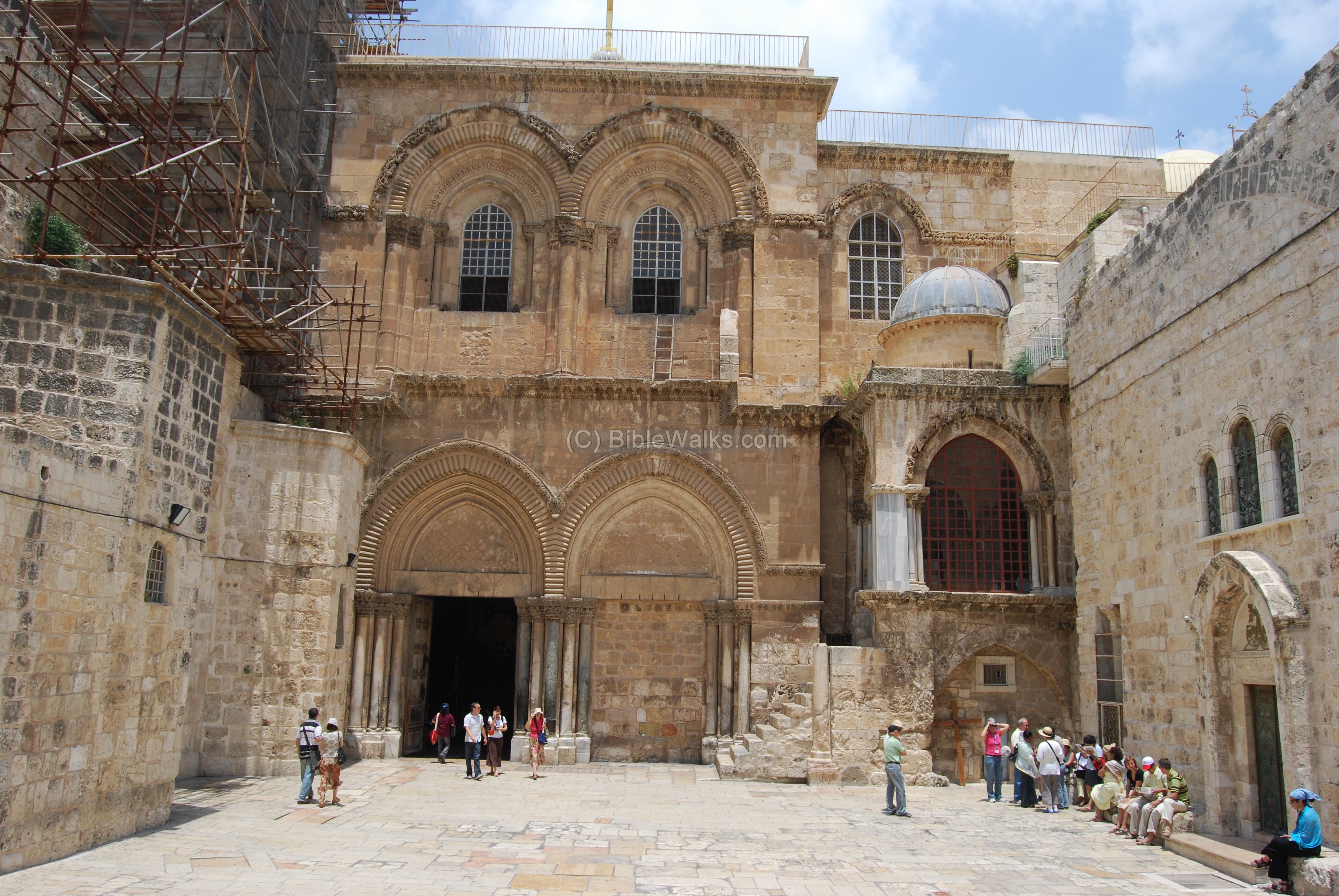
After passing the gate, there is an open yard before the church. On both sides of the yard are small churches, while the entrance to the Holy Sepulchre is located on the north side of the yard, as seen below.

This is the view from the yard on the south side of the church, where the main door is located. There are a pair of doors, but the right door is blocked off. On the right side are stairs that lead to the Catholic’s Chapel of the Franks, the 10th station on Via Dolorosa (- stripping off Jesus garments).
| In the base of the middle column on the left door is a large crack. There are reports on a fire that came out of that column in 1547. This incident is regarded by Greek Orthodox Christians as a miracle of the Holy fire that happened after they were banned from entering the Church, and helped them to reclaim rights of access. |
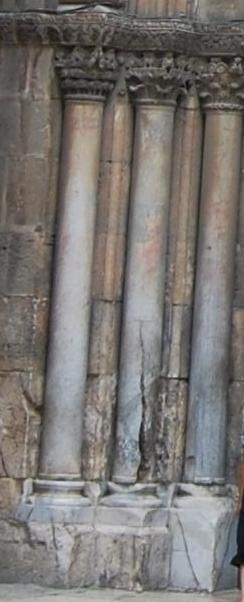
Other cases of the “Holy fire” occurred inside the church near the tomb of Jesus, or during a Greek Orthodox ceremony held on the night before Easter day. In such ceremonies the Patriarch lights up a fire, symbolizing the resurrection, and passes the fire to torches held by the crowd.
In one such case (1834) the fire caused a great panic, and hundreds of pilgrims that packed the halls were crushed when the crowd pushed their way out.
(c) Stone of Anointing (Unction):
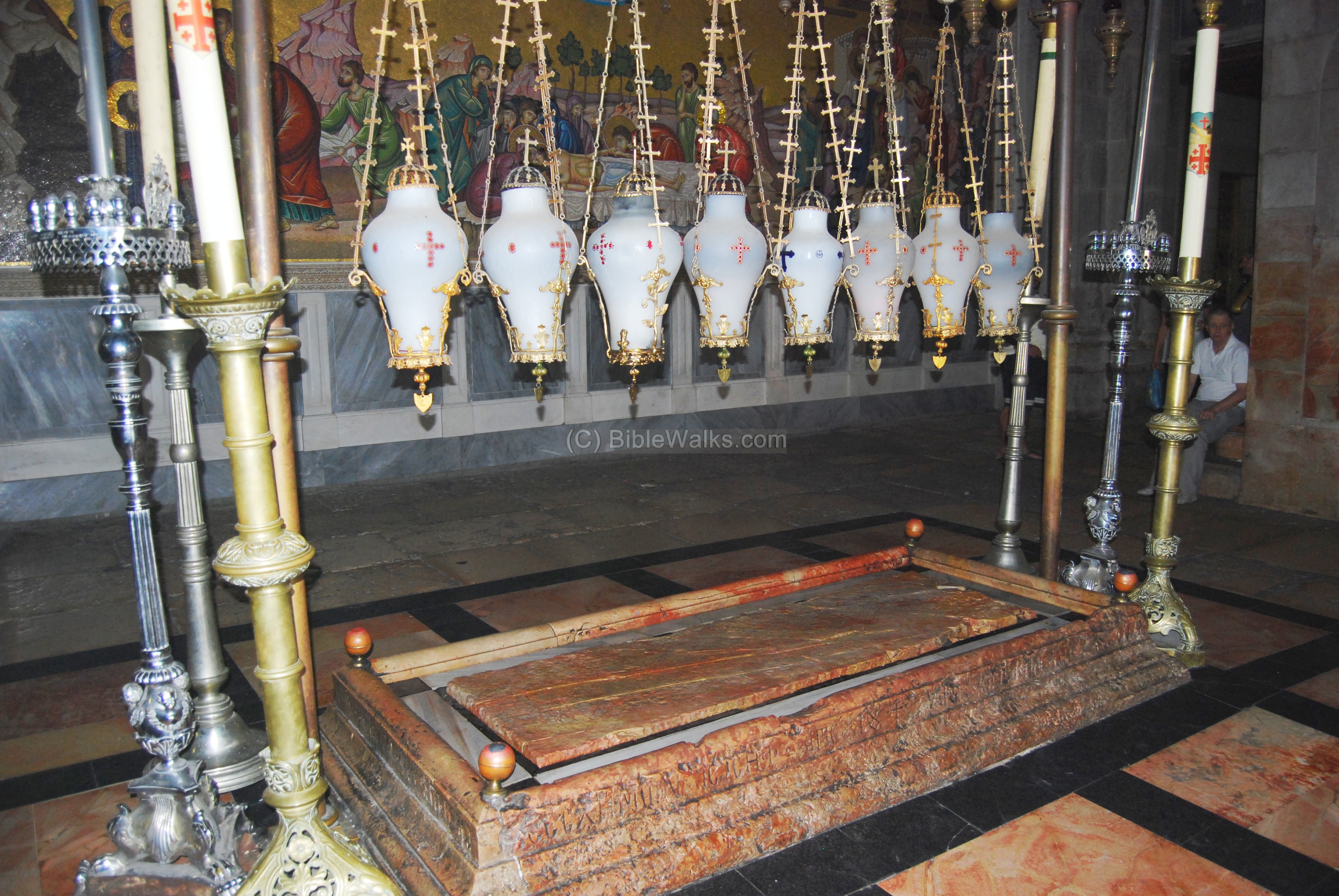
After entering the doors, the hall opens to the southern hall. On the floor near the entrance lays the stone of anointing. According to tradition, the body of Jesus was laid on this stone after it was removed from the cross.
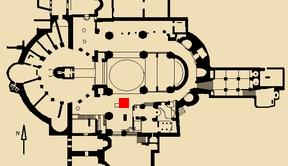
The plan of the church is seen here; the location of the stone of Anointing is marked by a red marker close to the southern main entrance.
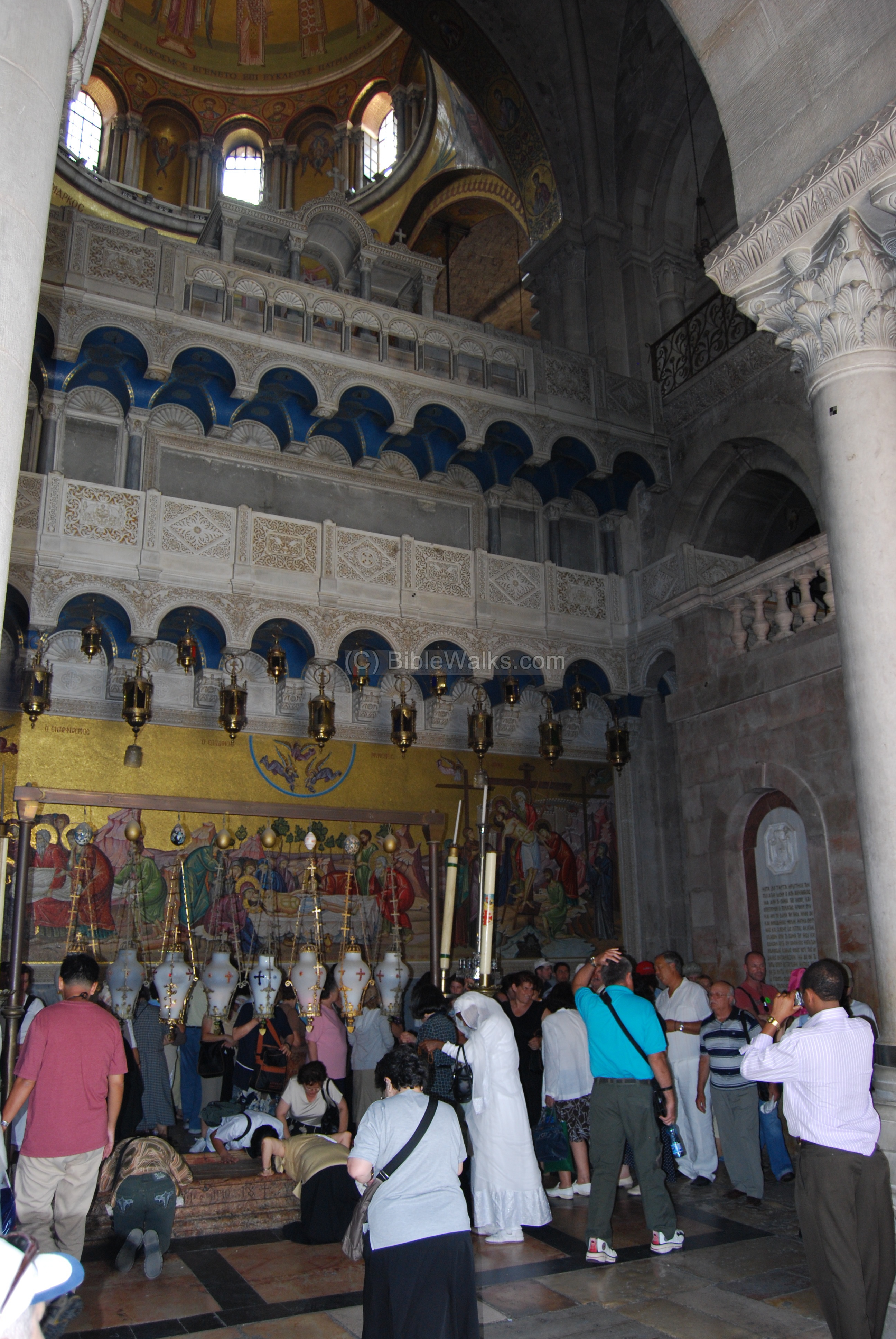
In the photo below – the stone of anointing (unction) greets the visitors, who kneel, pray and kiss the stone. Above the stone are lamps, each donated by one of the denominations.
This tradition is based on John 19: 40: “Then took they the body of Jesus, and wound it in linen clothes with the spices, as the manner of the Jews is to bury”.
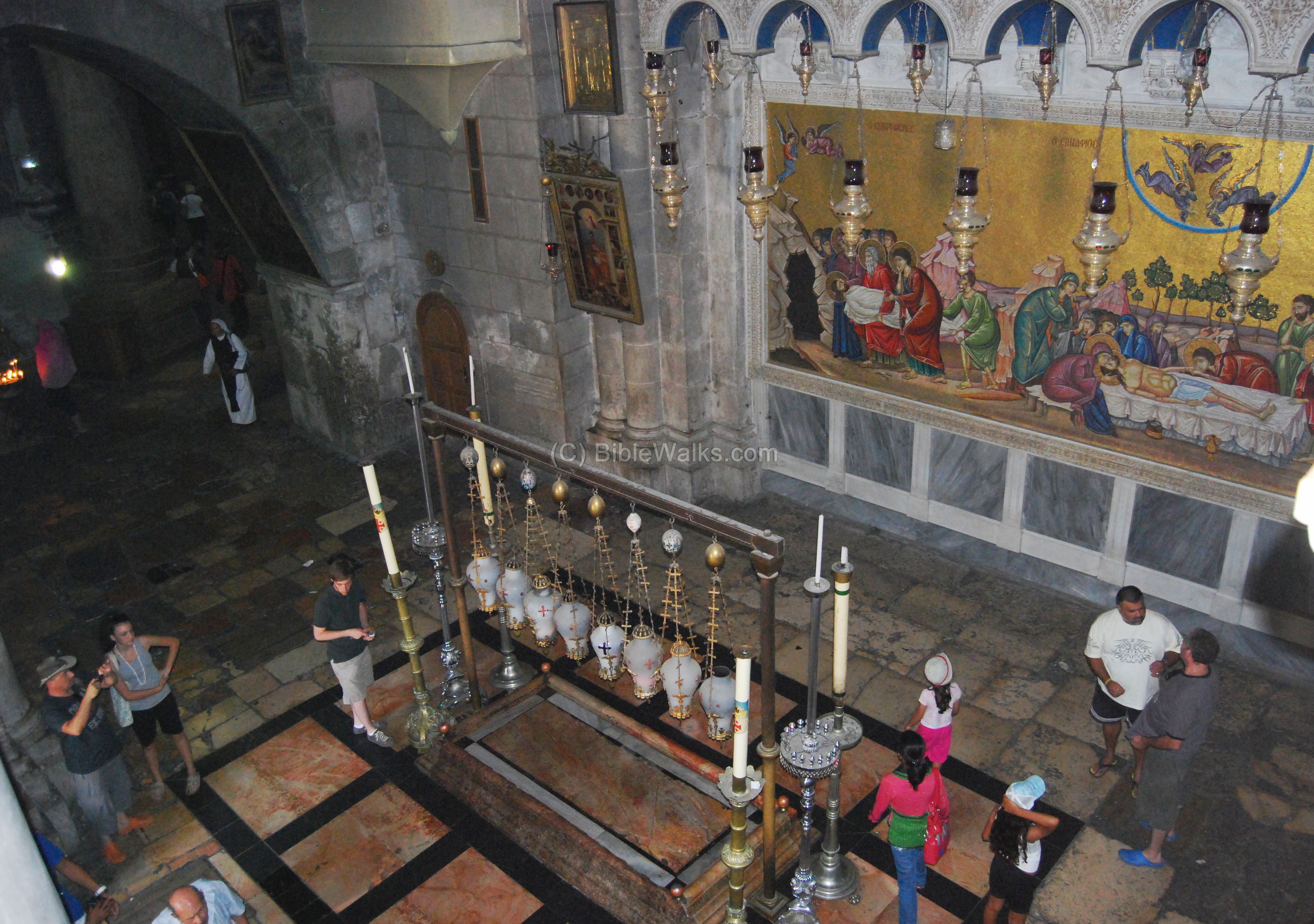
This is also illustrated on the wall mosaic above the entrance (see part of it here).

A closer view of the stone of Anointing:
A view from the from the Crucifixion altar – on the second floor – is seen below.
(d) Catholicon:
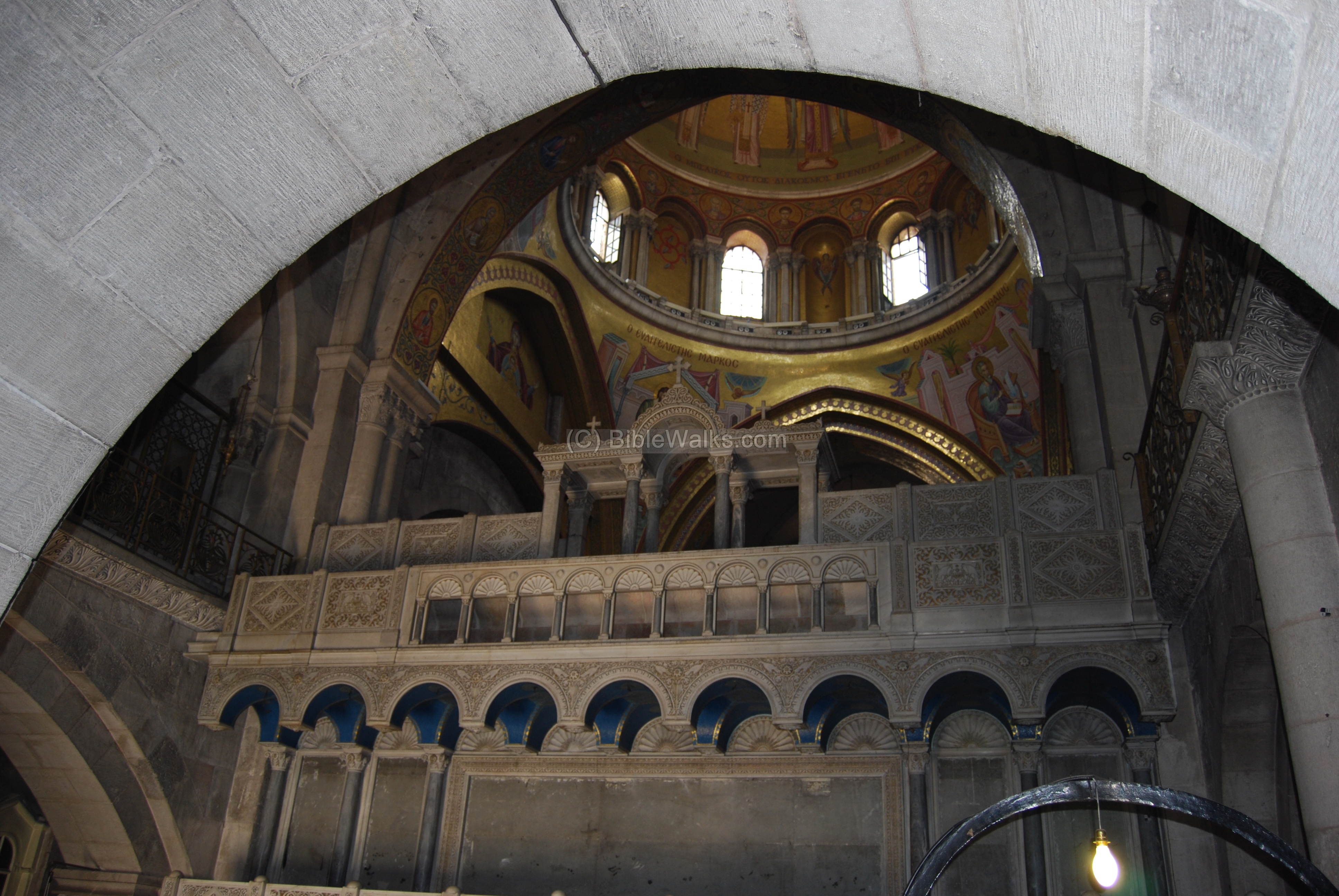
The eastern dome and galleries are part of the Catholicon (“general”). This is a large Greek Orthodox cathedral, seen in the photo below.
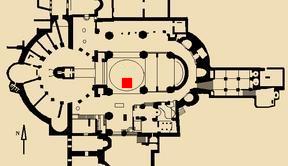
The plan of the church is seen here, with the location of the cathedral marked by a red marker in the center of the church.
The Catholicon, which parts of it is seen below, was the main part of the Crusader church.
(e) Armenian Chapel:
West to the Anointing stone is a small Armenian shrine, seen in the photo below.
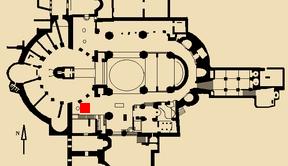
The plan of the church is seen here, with the location of the Chapel marked by a red marker on the southern side of the Rotunda.
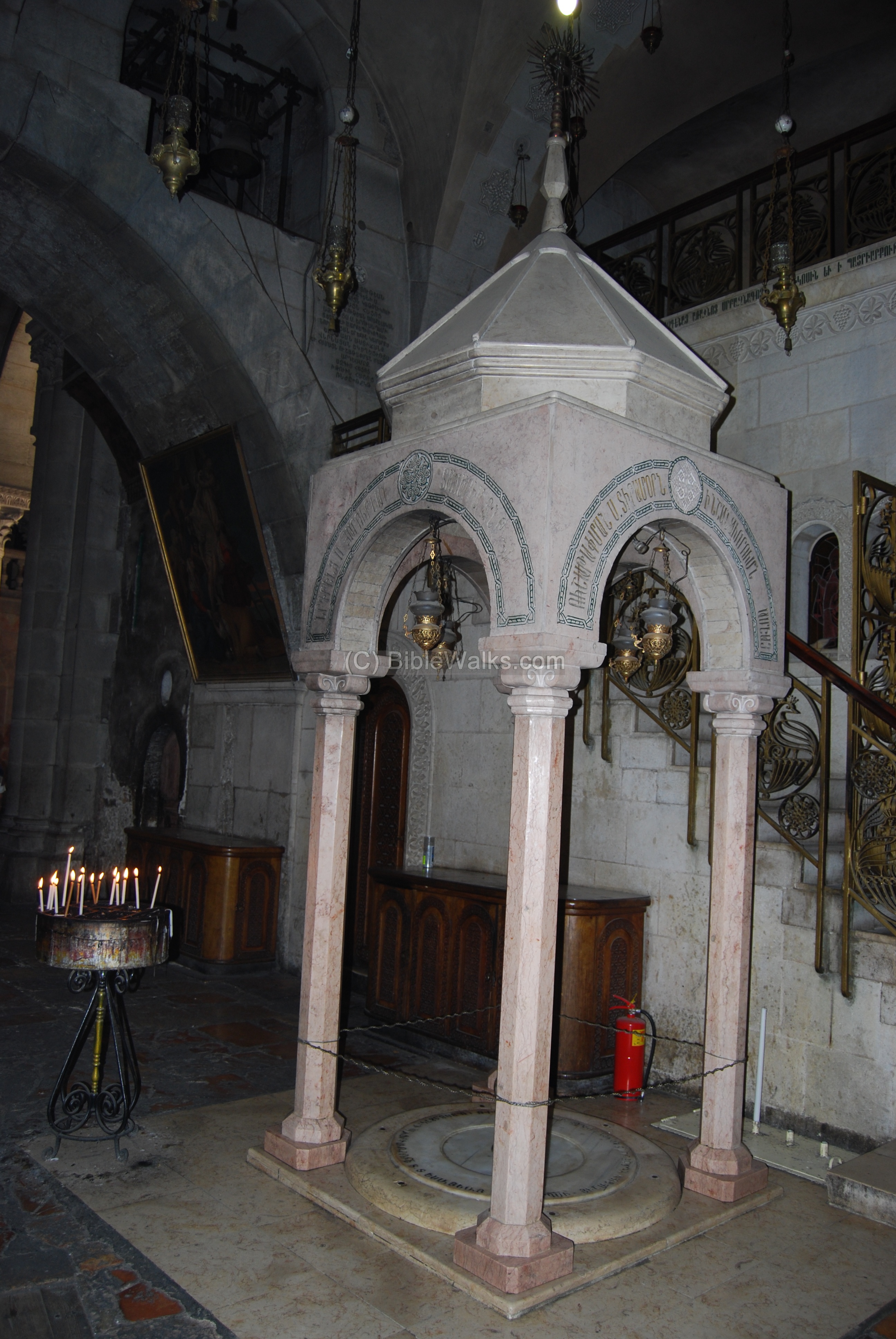
The photo below shows a view from the east side.

(f) Rotunda and Aedicule:
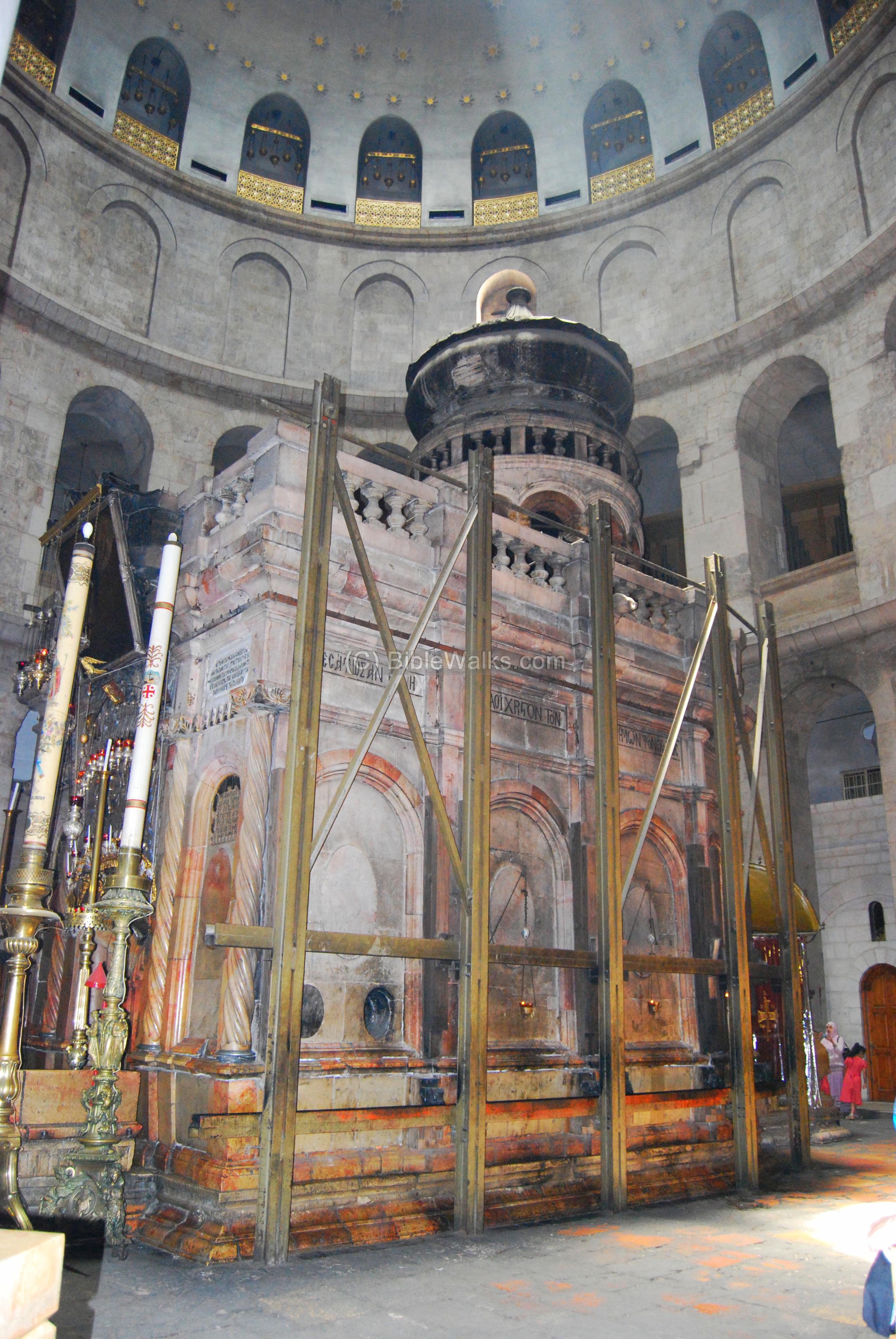
The heart of the Holy Sepulchre is a round hall (“Rotunda”). Here, in the center of the circle, the tomb of Jesus is located in a smaller structure – the Aedicule – which has two chambers (the Chapel of the Angle and the room of the tomb).
The plan of the church is seen here, with the location of the Rotunda marked by a red marker on the western side of the church, below the main dome. The tomb is marked by an orange color in the center.

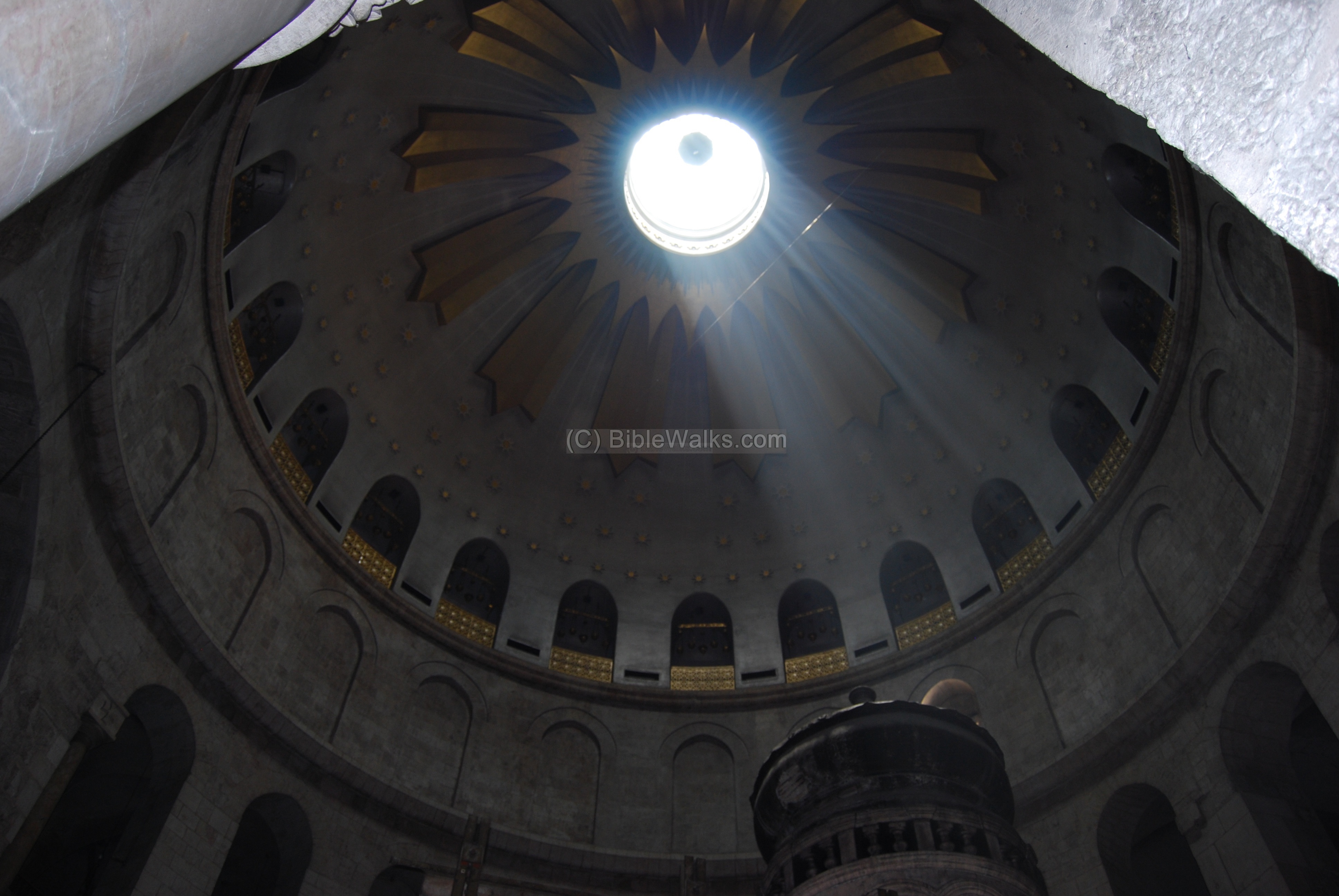
The photo below shows the ceiling of the hall. The natural light filters in from the top of the cape, casting a holy spell over the hall. The dome, 11M high, is supported by 18 massive columns, and the only major part in the church that corresponds to the Constantine church.
The tomb of Jesus is located in the center of the hall, within the structure (Aedicule) seen below.
(g) Chapel of the Angel:
The entrance to the tomb is through a narrow door on the east side. There is normally a queue to the enter the inner chamber.
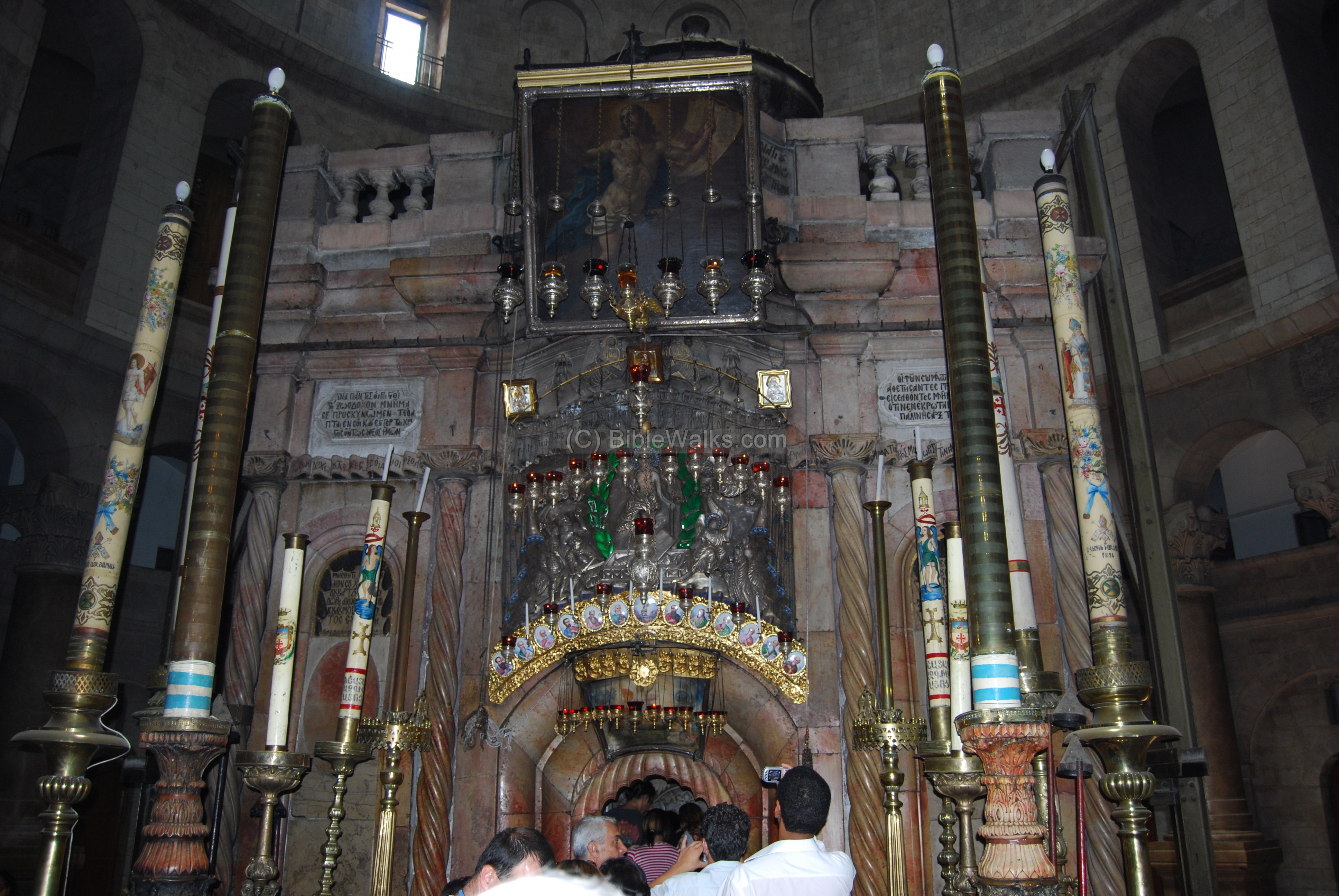
The first chamber is called the “Chapel of the Angel”. A fragment of the blocking stone of the Sepulchre is stored here. It is called after the angel that removed the stone. The Biblical text (Matthew 28 2-3): “And, behold, there was a great earthquake: for the angel of the Lord descended from heaven, and came and rolled back the stone from the door, and sat upon it. His countenance was like lightning, and his raiment white as snow”).
(h) Tomb of Jesus:
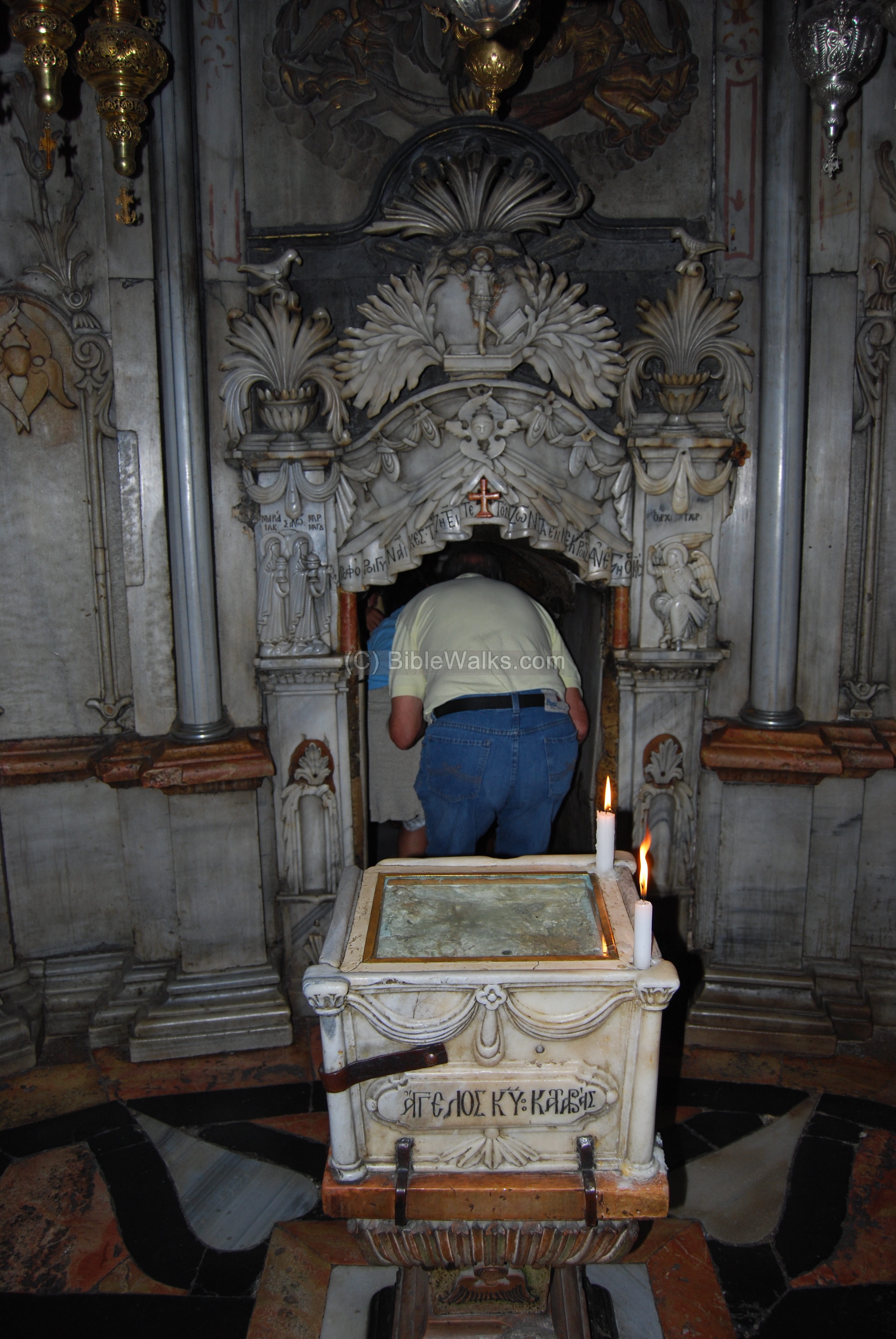
Behind the Chapel is another narrow door which leads to a smaller chamber – the tomb of Jesus.
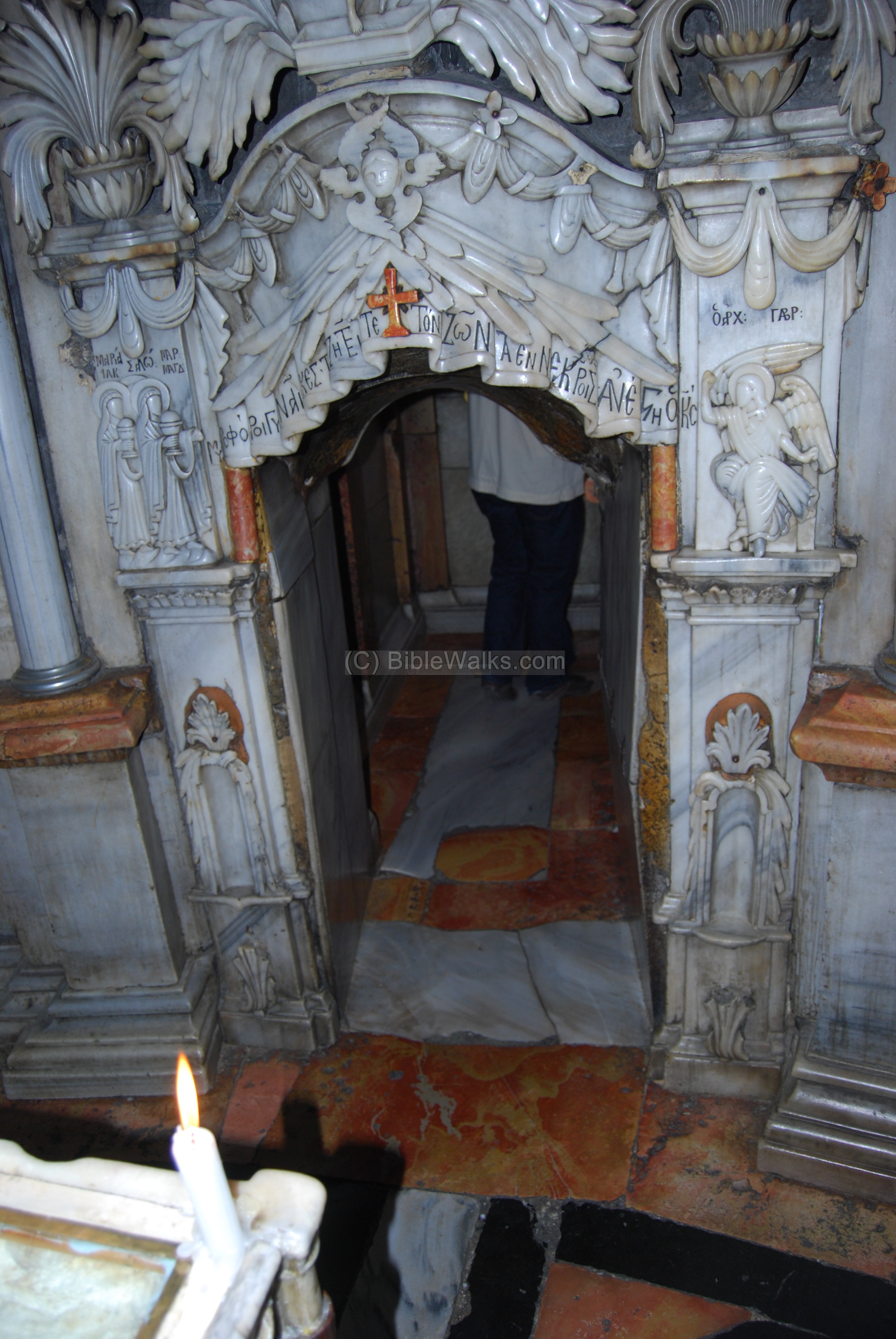
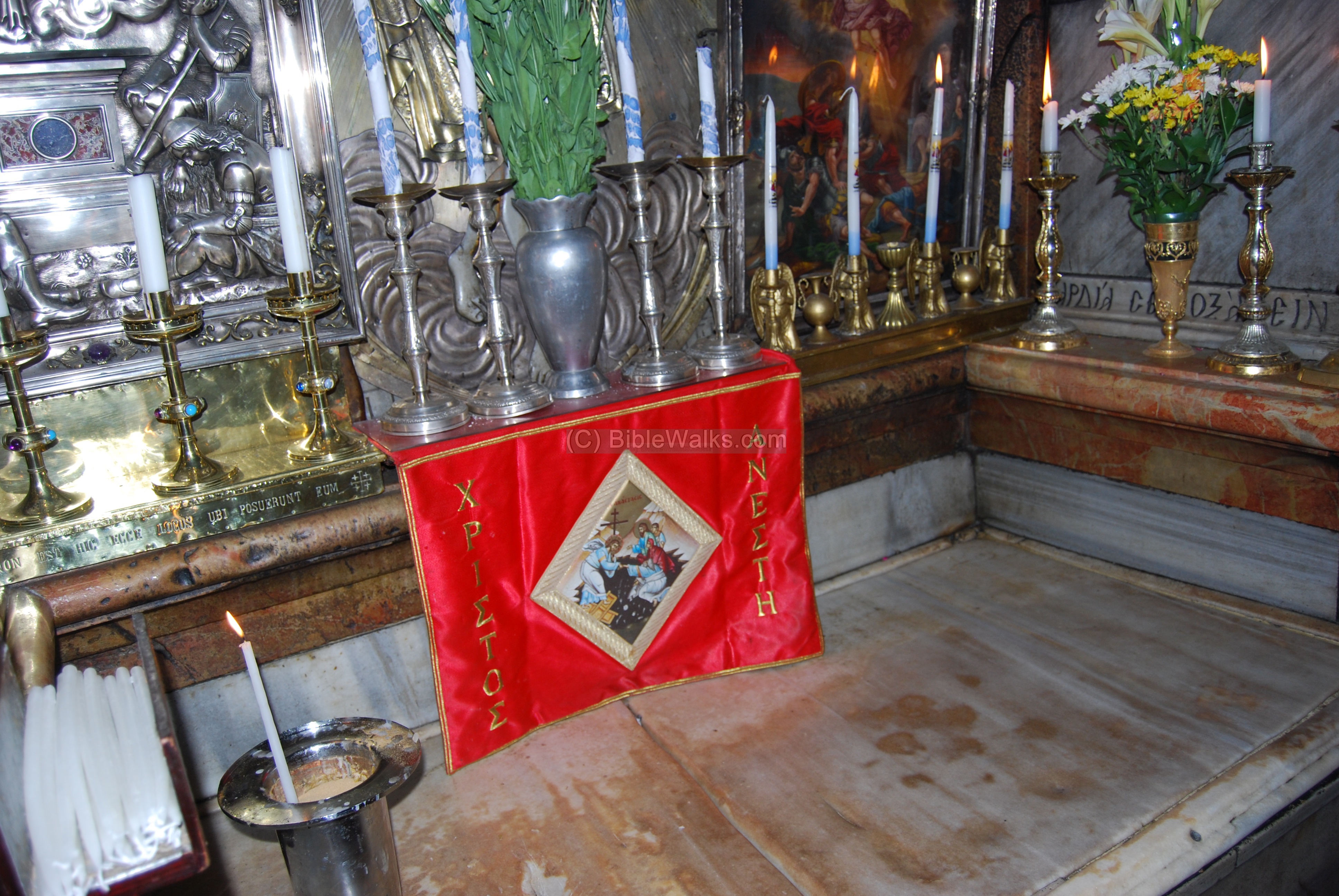
Parts of the tomb’s interior is seen below. The room of the tomb is 2M by 93cm. A marble lid covers the tomb.
(i) Coptic Chapel:
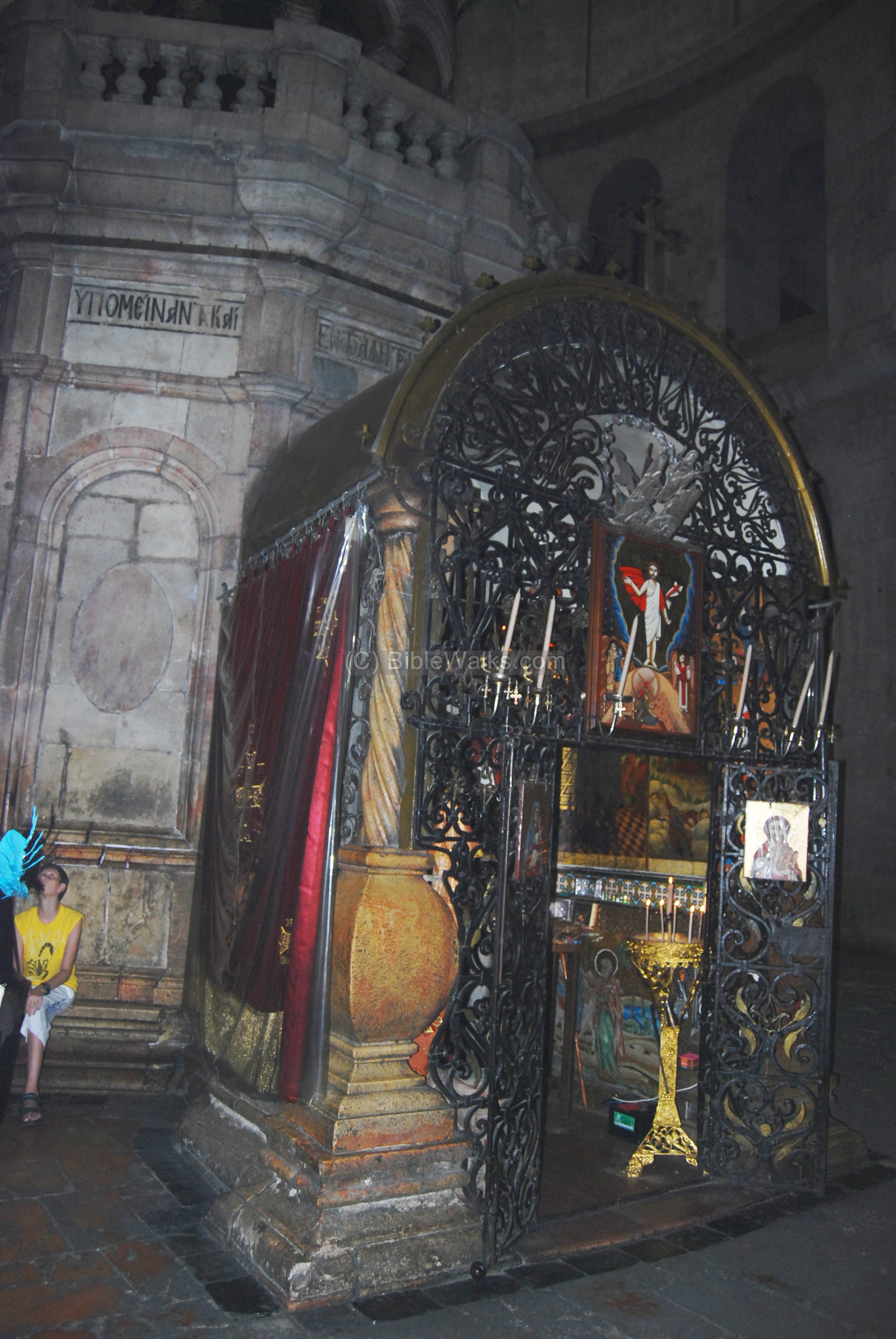
Behind the tomb of Jesus is the Coptic chapel .
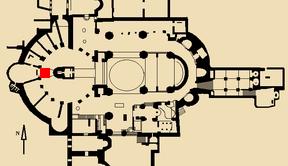
The plan of the church is seen here, with the location of the Chapel marked by a red marker on the western side of the church, adjacent to the Tomb of Jesus.
(j) Jacobite Chapel:
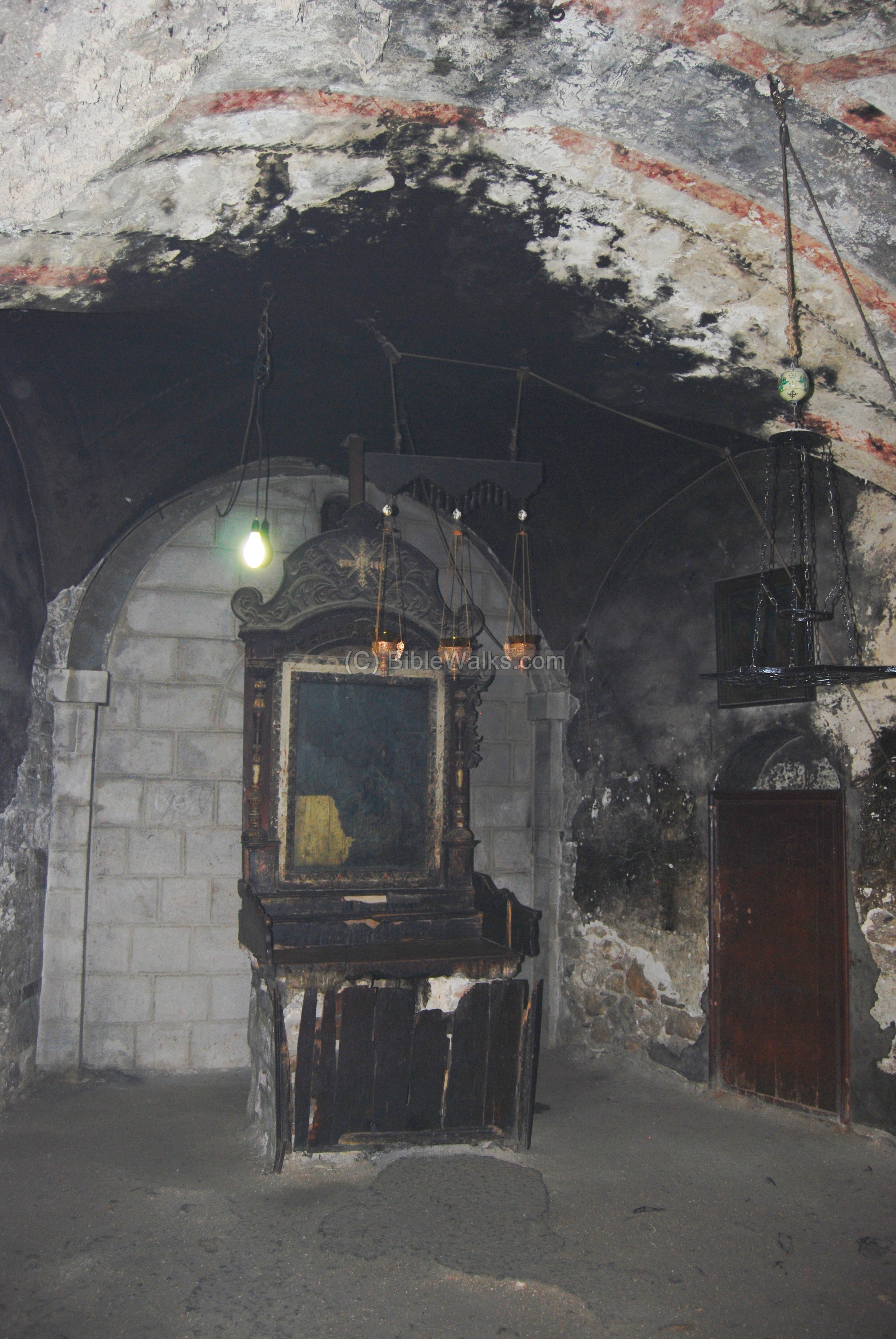
Behind the tomb of Jesus, on the western side of the Rotunda walls, is the Jacobite (Syrian Orthodox) chapel.
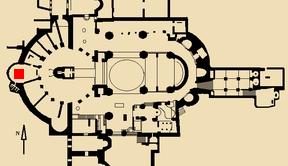
The plan of the church is seen here, with the location of the Chapel marked by a red marker on the western side of the church.
The chapel, seen below, is located in the 4th century Constantine church walls. The altar and walls around it were damaged by fire. On the southern side of the chapel are 1st century Jewish tombs. According to tradition, they are of Joseph of Arimathea and Nikodemus who took down and buried the body of Jesus (Luke 23: 50-56).
(k) Chapel of Mary Magdalene:
On the north side of the Rotunda, the hall of the tomb, is the Franciscan Chapel of Mary Magdalene. Mary of Magdala (Migdal) accompanied Jesus on his way to the cross and burial (Mark 15, 47: “And Mary Magdalene and Mary the mother of Jesus beheld where he was laid”) .
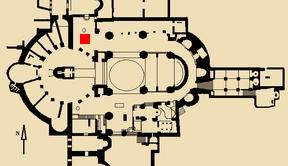
The plan of the church is seen here, with the location of the Chapel marked by a red marker on the north-western side of the church, adjacent to the Rotunda.
The altar is on the left side (shown on the next picture), while the Rotunda is seen in the background. On the north side of the chapel are more rooms.
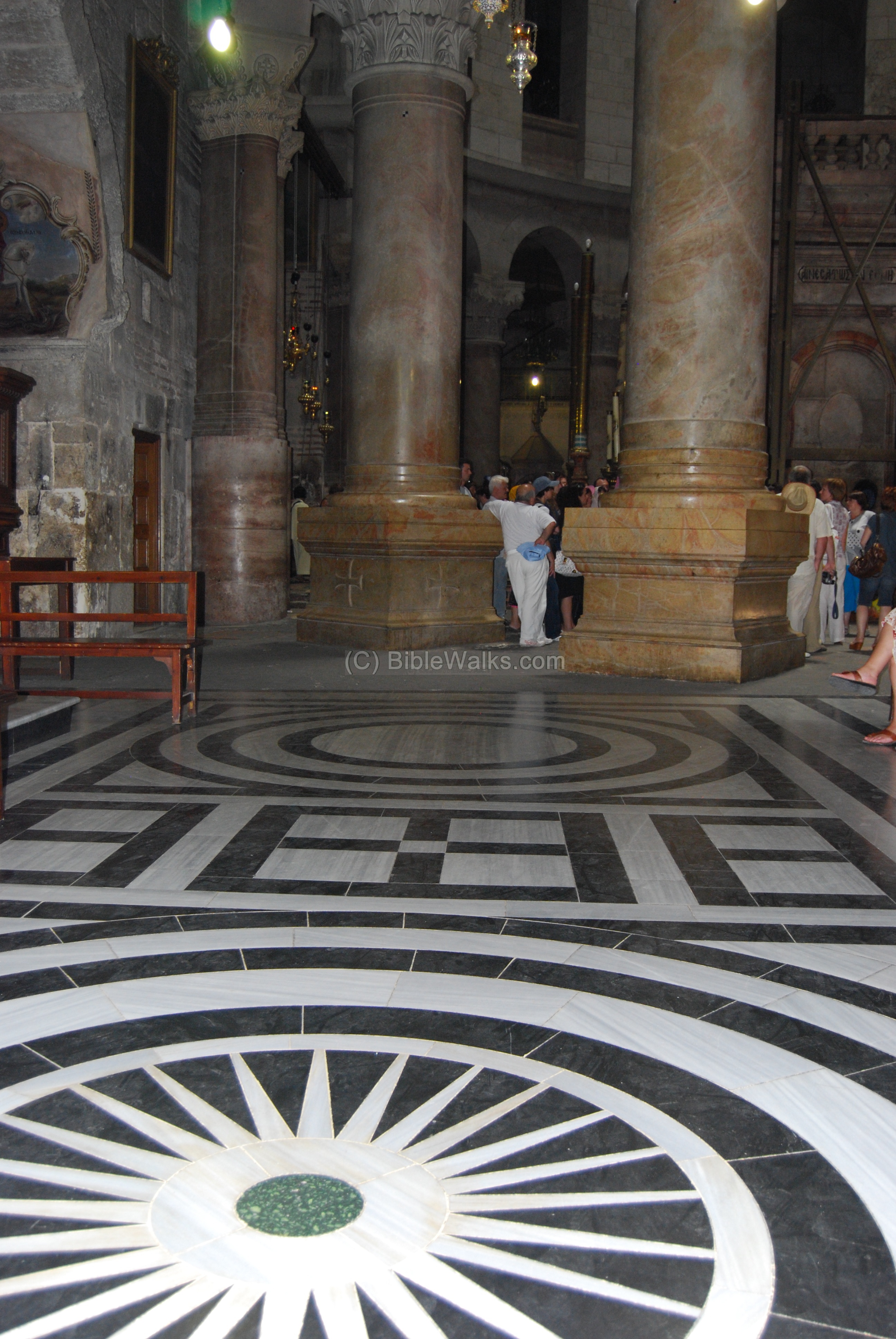
A view of Mary Magdalene is seen in the photo below.

(l) Greek Orthodox chapel – Prison of Jesus:
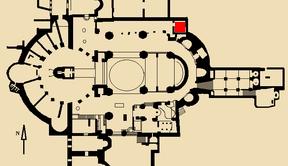
On the North-Eastern side of the Church, walking around the northern ambulatory, is a Greek Orthodox chapel of the Prison of Jesus.
See plan of the church; the location is marked by a red marker on the north-eastern corner of the church.
A view of the chapel at the end of the northern walls is seen below. According to tradition, Jesus and the two thieves were housed here before the crucifixion.

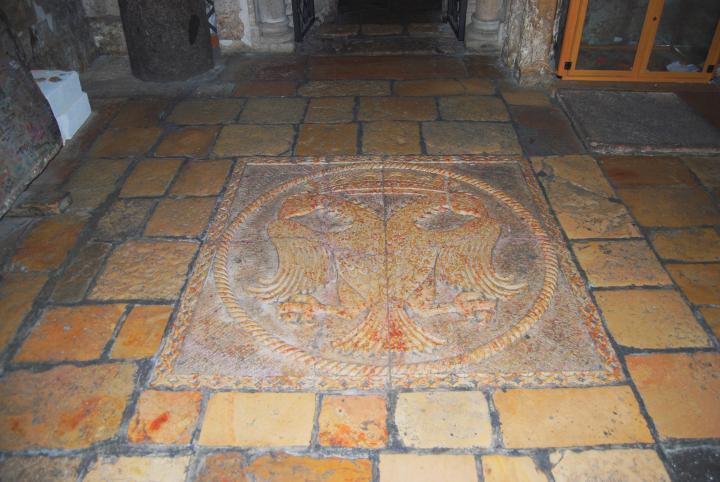
On the floor, in front of the chapel, is a mosaic figure of a double headed eagle – symbol of the Byzantine empire and the Greek Orthodox church.
Before the entrance to the Prison of Jesus is a smaller chapel of the handcuffs of Jesus, seen on the right side.
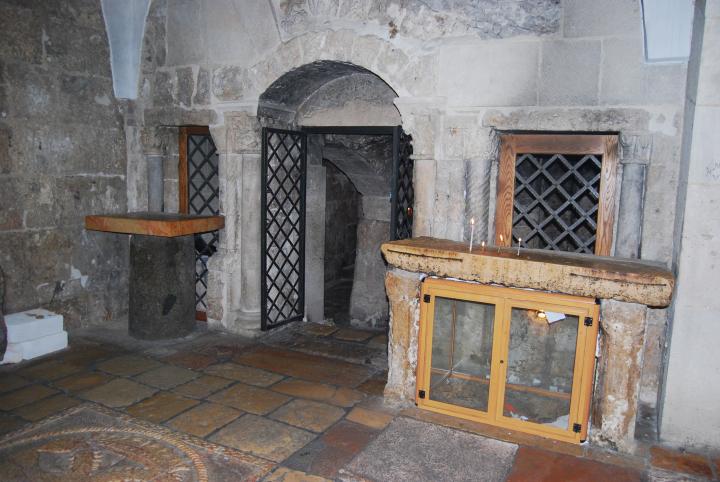
Under the altar, behind a glass window, are two holes in the floor. According to tradition, these holes (seen below) are the imprints of the feet of Jesus. Pilgrims leave notes inside the window.

Inside the inner room is the chapel of Prison of Jesus.

A closer view of the altar is seen below. Pilgrims, who come to pray here, light up candles which leave black smoke marks on the walls.
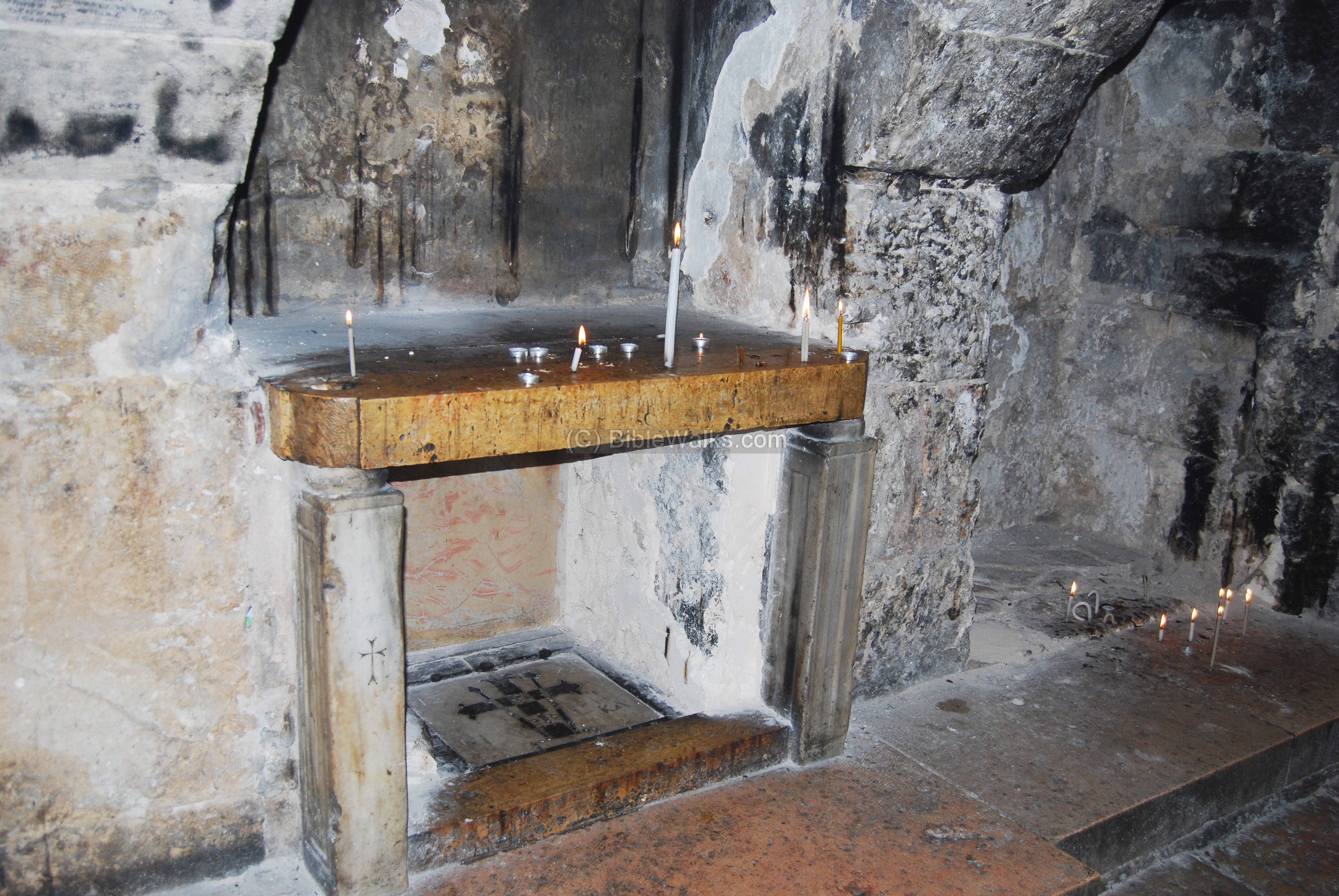
(m) Greek Orthodox chapel – St. Longinus:
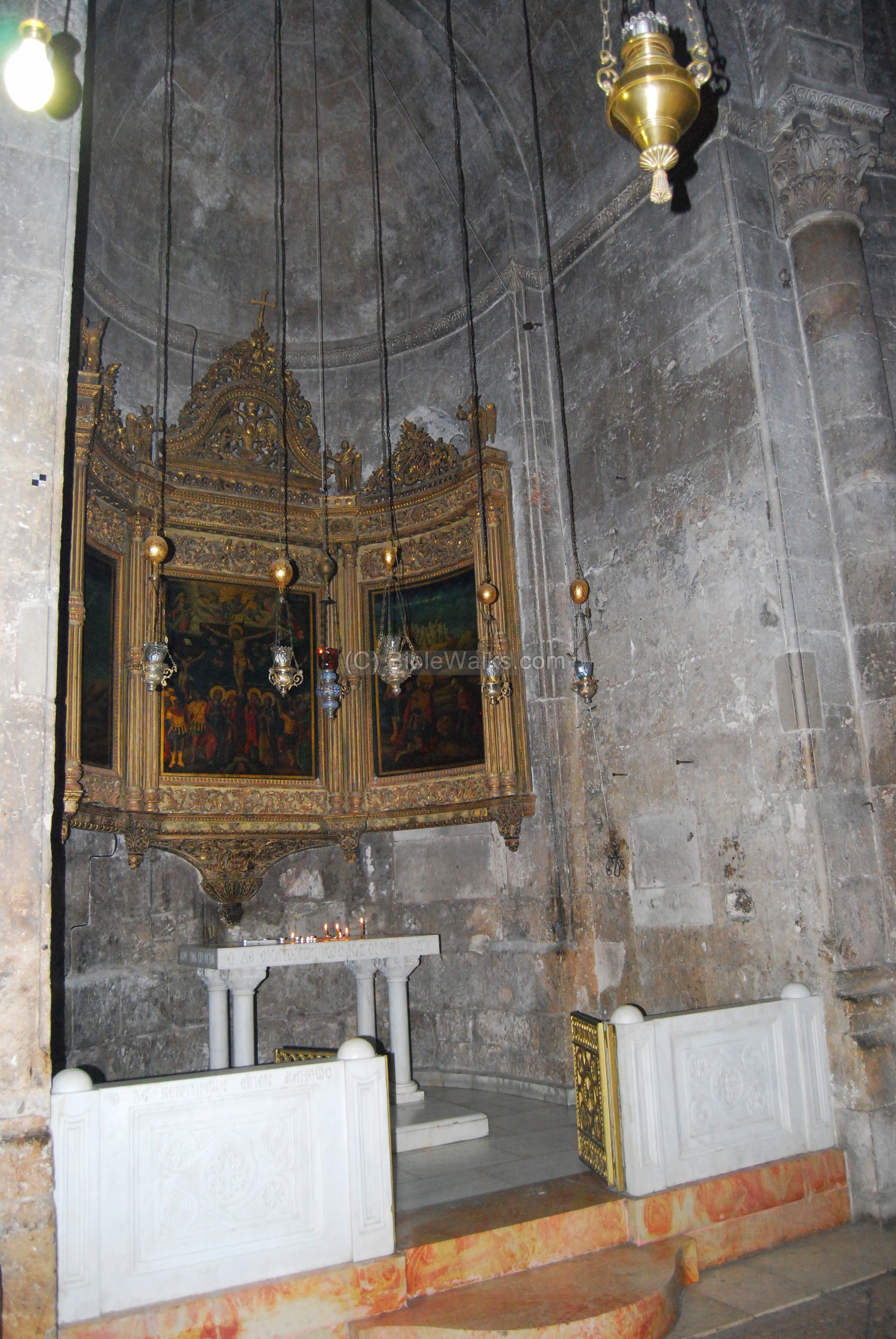
Along the eastern ambulatory of the Church are three chapels – St Longinus, Division of the Holy Robes and the Derision chapel. The first of these three chapels is the Greek Orthodox chapel of St. Longinus.
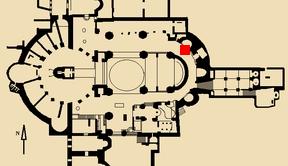
See plan of the church ; the location is marked by a red marker on the north-eastern side of the church, near Jesus Prison.
This chapel memorizes another event of the crucifixion. Longinus, a Roman Centurion who commanded the soldiers that stood watch at Golgotha, was an eyewitness of the final moments of Jesus. This shock his soul and he later confessed (Matthew 27, 54): “Now when the centurion, and they that were with him, watching Jesus, saw the earthquake, and those things that were done, they feared greatly, saying, Truly this was the Son of God”.
(n) Armenian chapel – Division of Holy Robes:
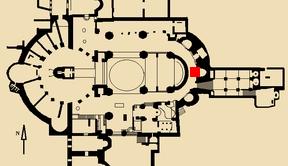
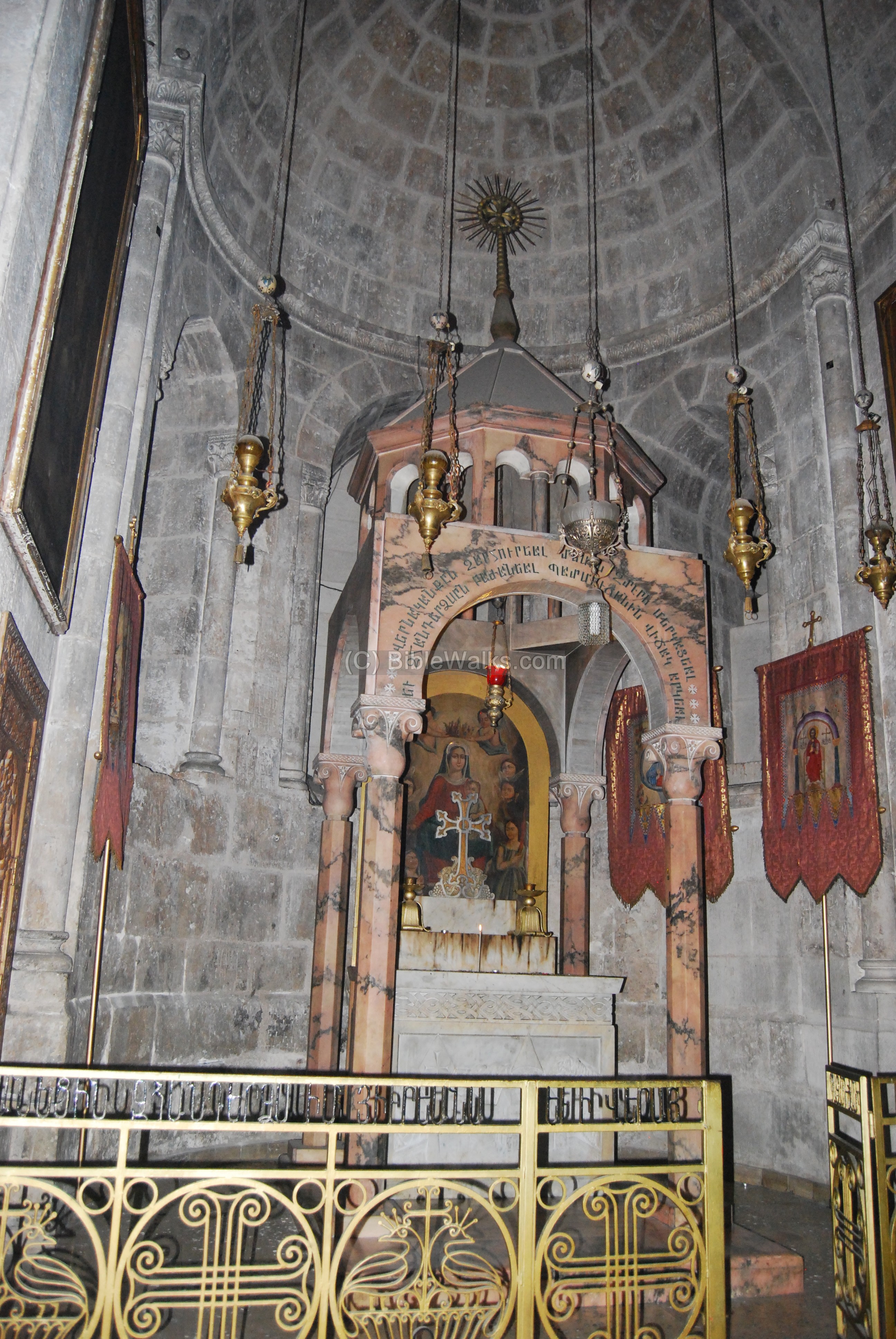
On the eastern side of the Church is an Armenian chapel of the Division of the Holy Robes.
See plan of the church here; the location is marked by a red marker on the eastern side of the church, near the steps to the underground level.
This chapel memorizes the event when the soldiers divided Jesus’ clothes as booty. As per the Bible (John 19 23): “Then the soldiers, when they had crucified Jesus, took his garments, and made four parts, to every soldier a part; and also his coat: now the coat was without seam, woven from the top throughout.”.
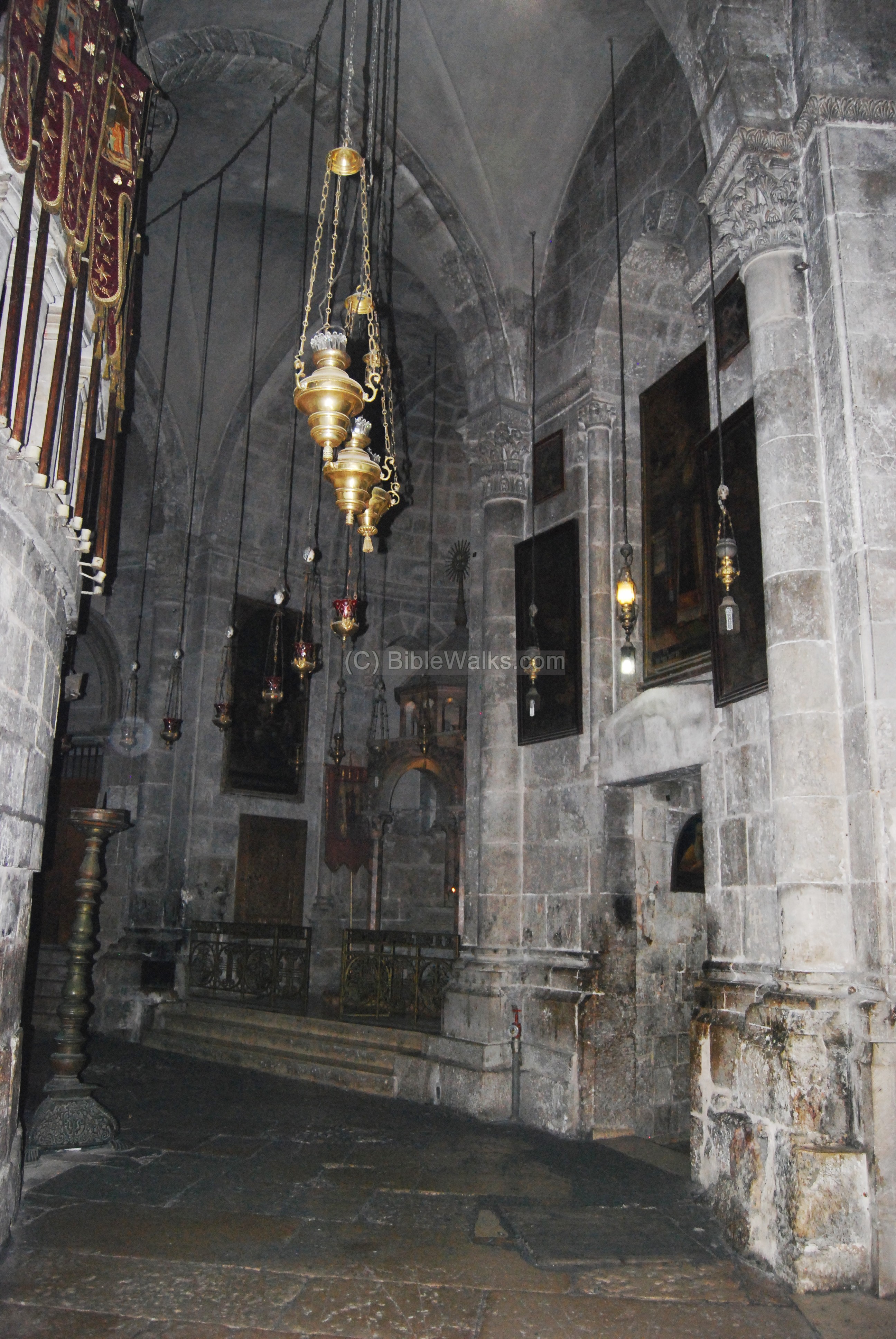
A view of the chapel, and its location in the eastern side of the Church, is seen below. The steps down to St. Helen are seen on the right side.
(o) St. Helen Chapel:
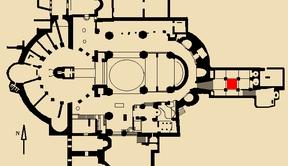
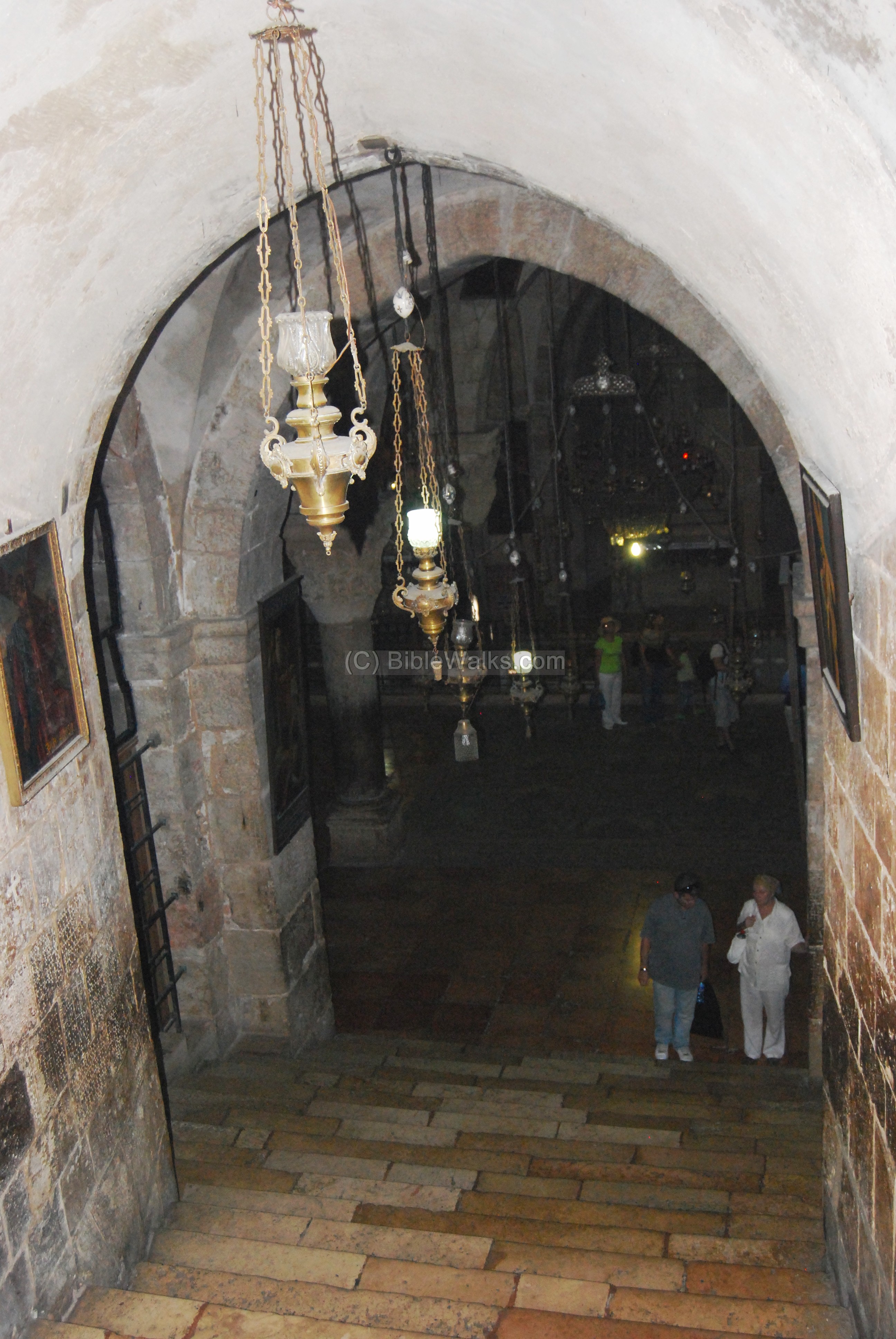
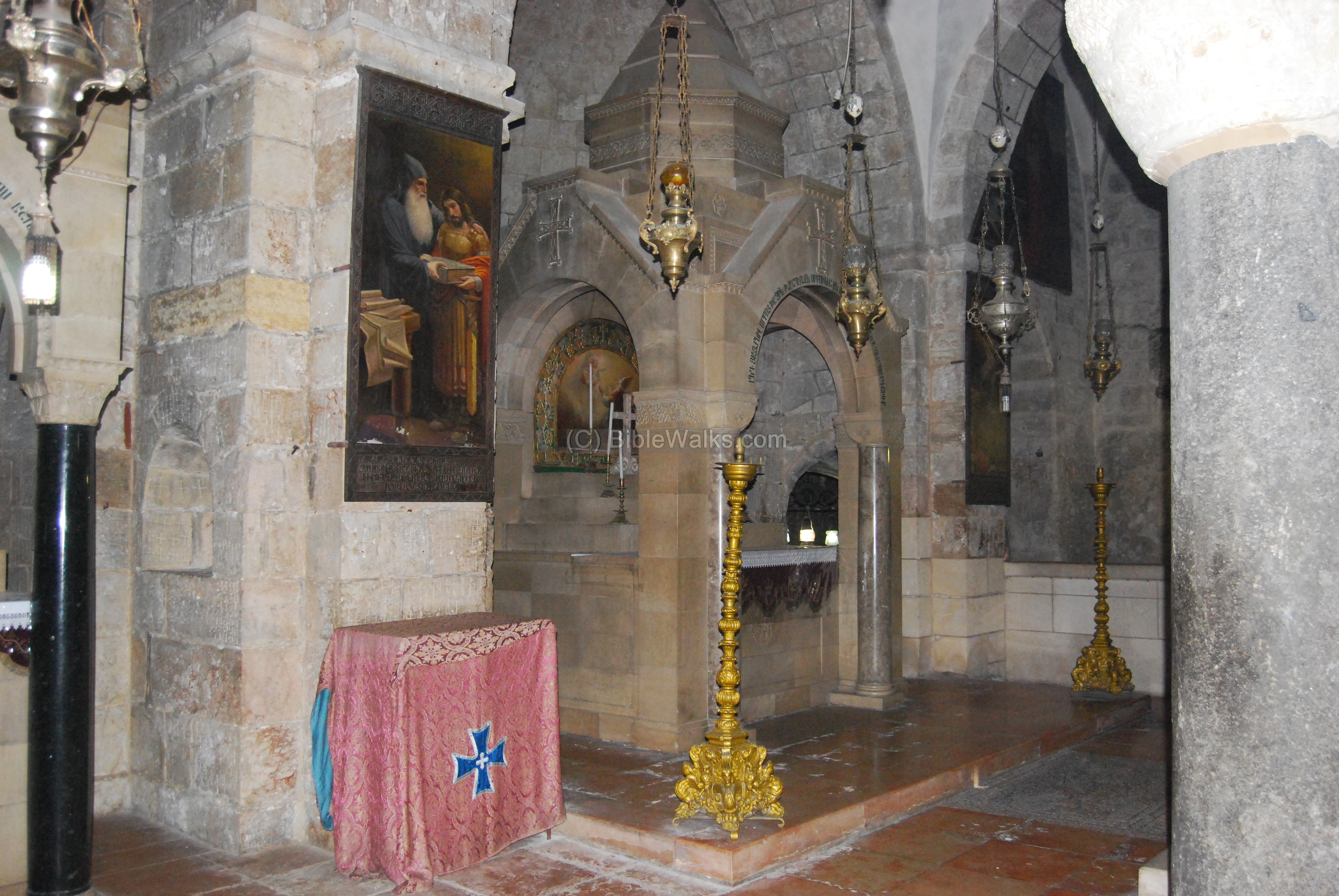
On the east side of the Church are 29 steps that lead down to the Chapel of St. Helena, honoring the mother of Emperor Constantine who discovered the cross and vault in her visit (326 AD). This is a beautiful Armenian chapel.
See plan of the church here; the location is marked by a red marker on the eastern side of the church, in an underground level.
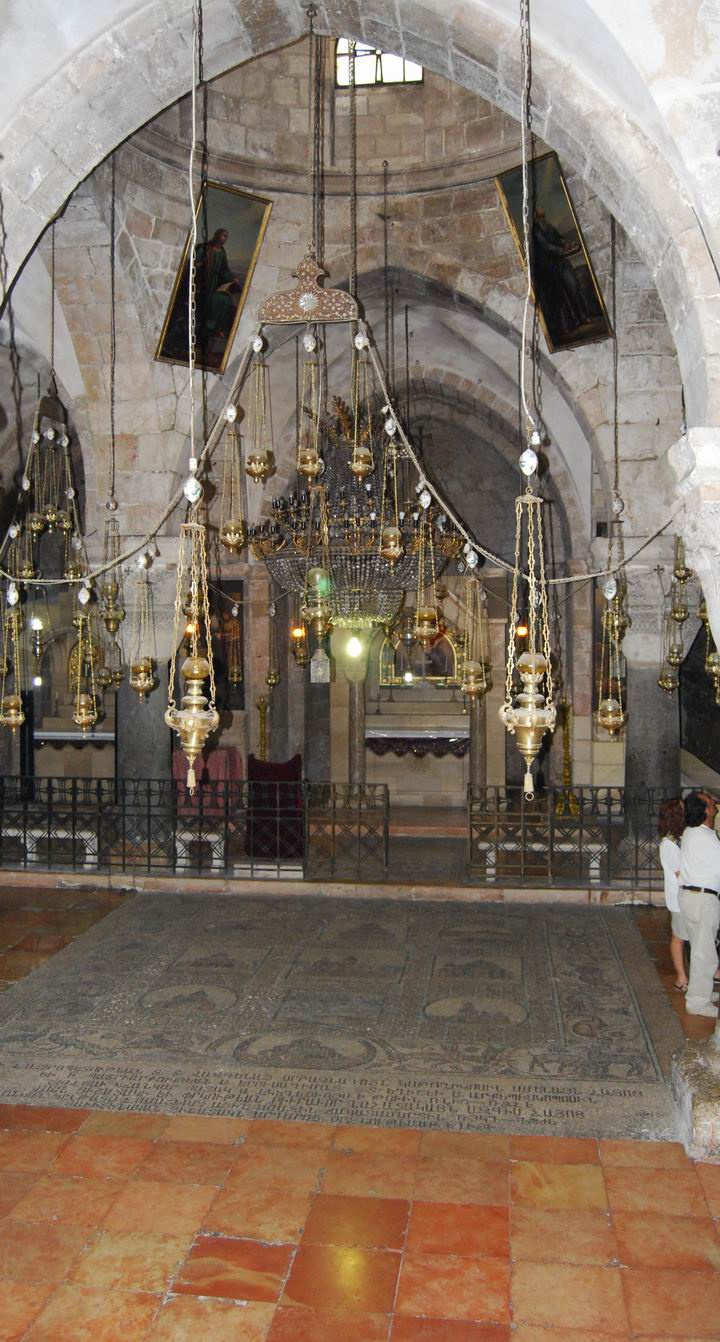
Along the walls of this wide staircase is ancient graffiti of crosses, as seen below. Those were scratched by medieval pilgrims.
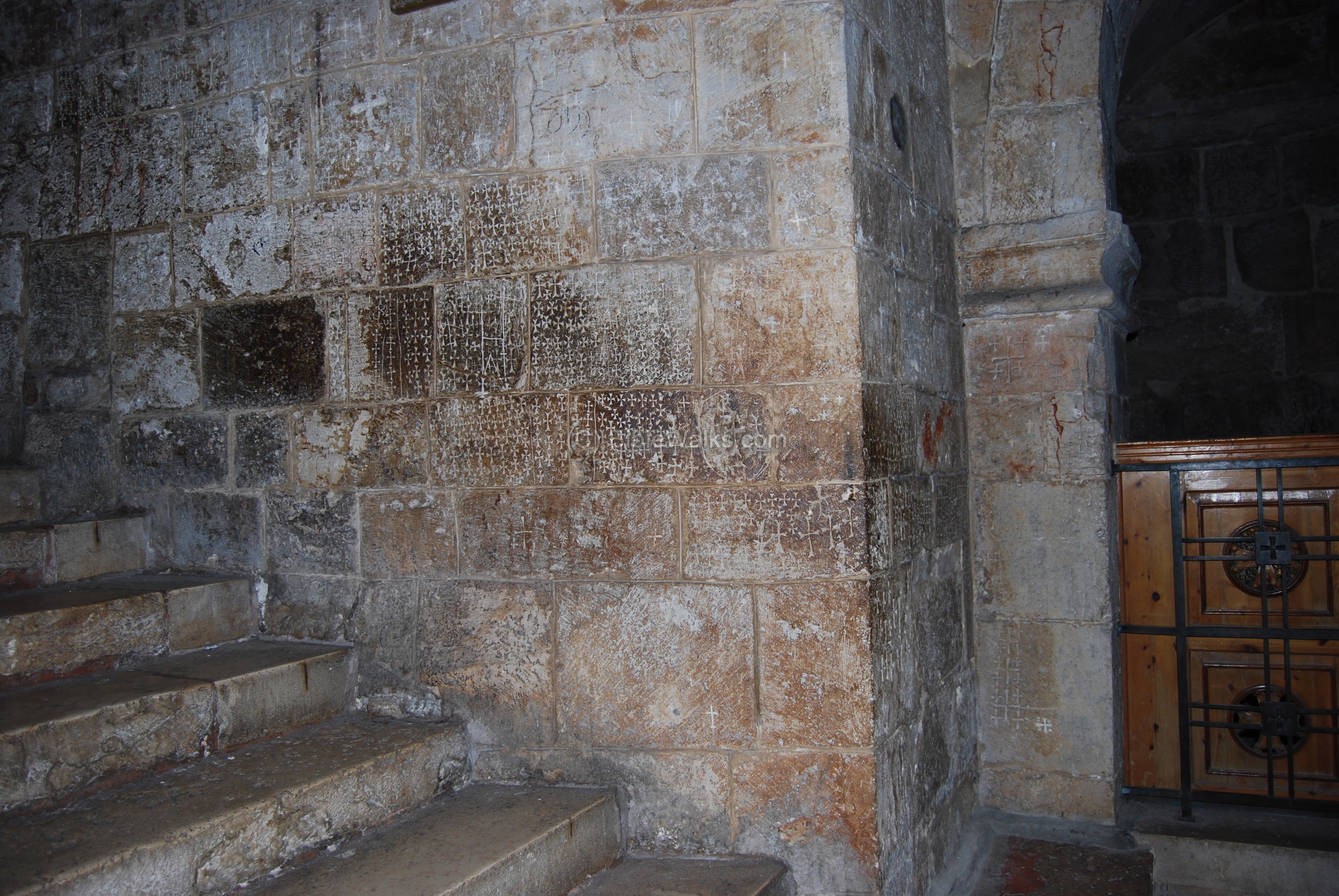
The photo below shows the interior of the chapel with its large mosaic floor.
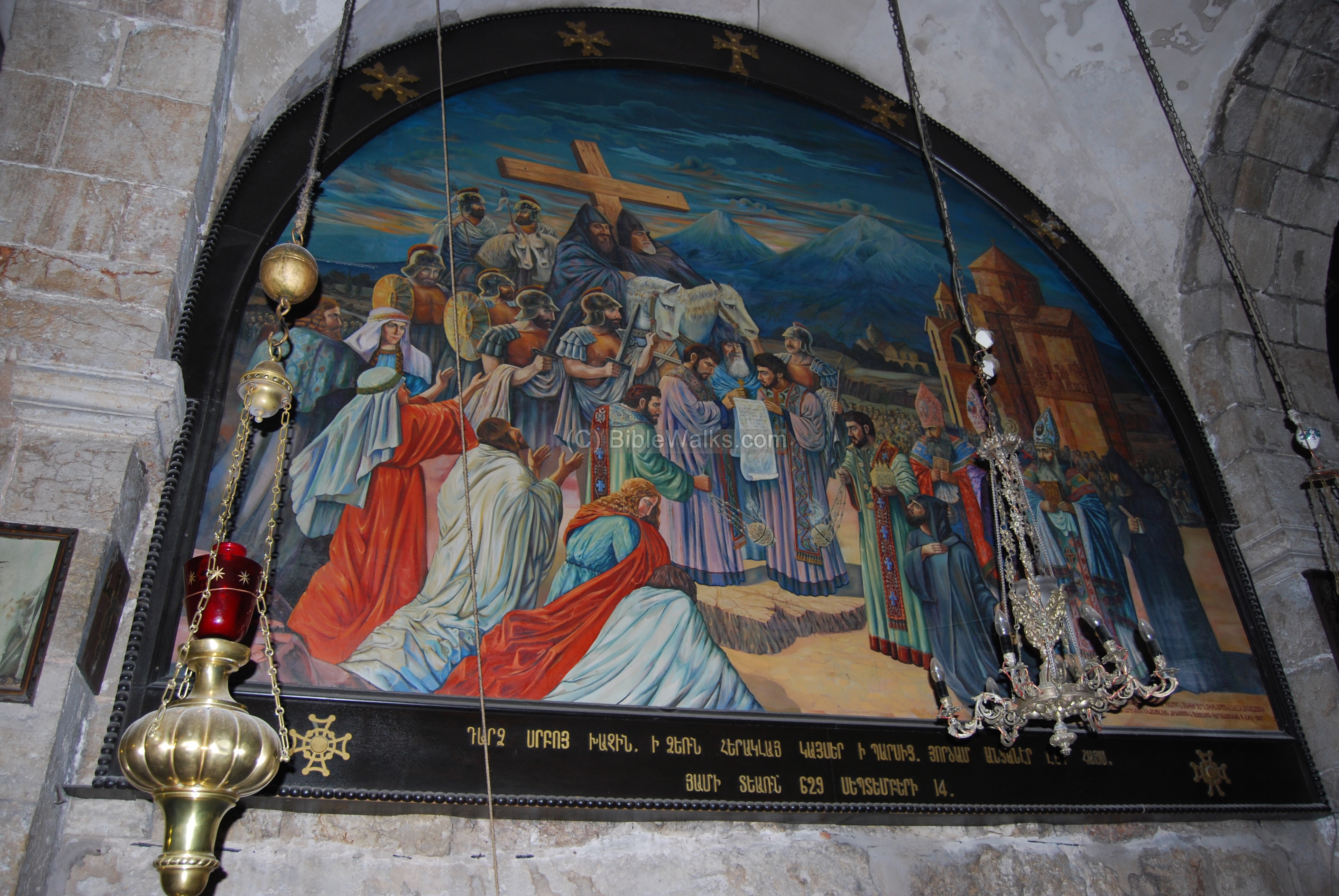
On the south side is a large painting showing the scene of the discovery of the cross.
A smaller chapel is located on the north side of the main altar, and is dedicated to the “Good” (penitent) thief, St. Dimas (Dysmas). This thief, crucified alongside Jesus, repents of his sins and asks Jesus to remember him in his kingdom (Luke 23 42): “Then he said, “Jesus, remember me when you come into your kingdom.”.
(p) Finding of the Cross Chapel :
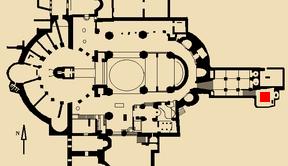
At the lowest chamber, 13 stairs under the Chapel of St. Helena (and towards east), is a cave called the “Finding of the Cross”.
See plan of the church here; the location is marked by a red marker on the most eastern side of the church, two levels below the main floor.
This is the place where Helena, mother of Emperor Constantine, found the fragments of the cross (on the right side).
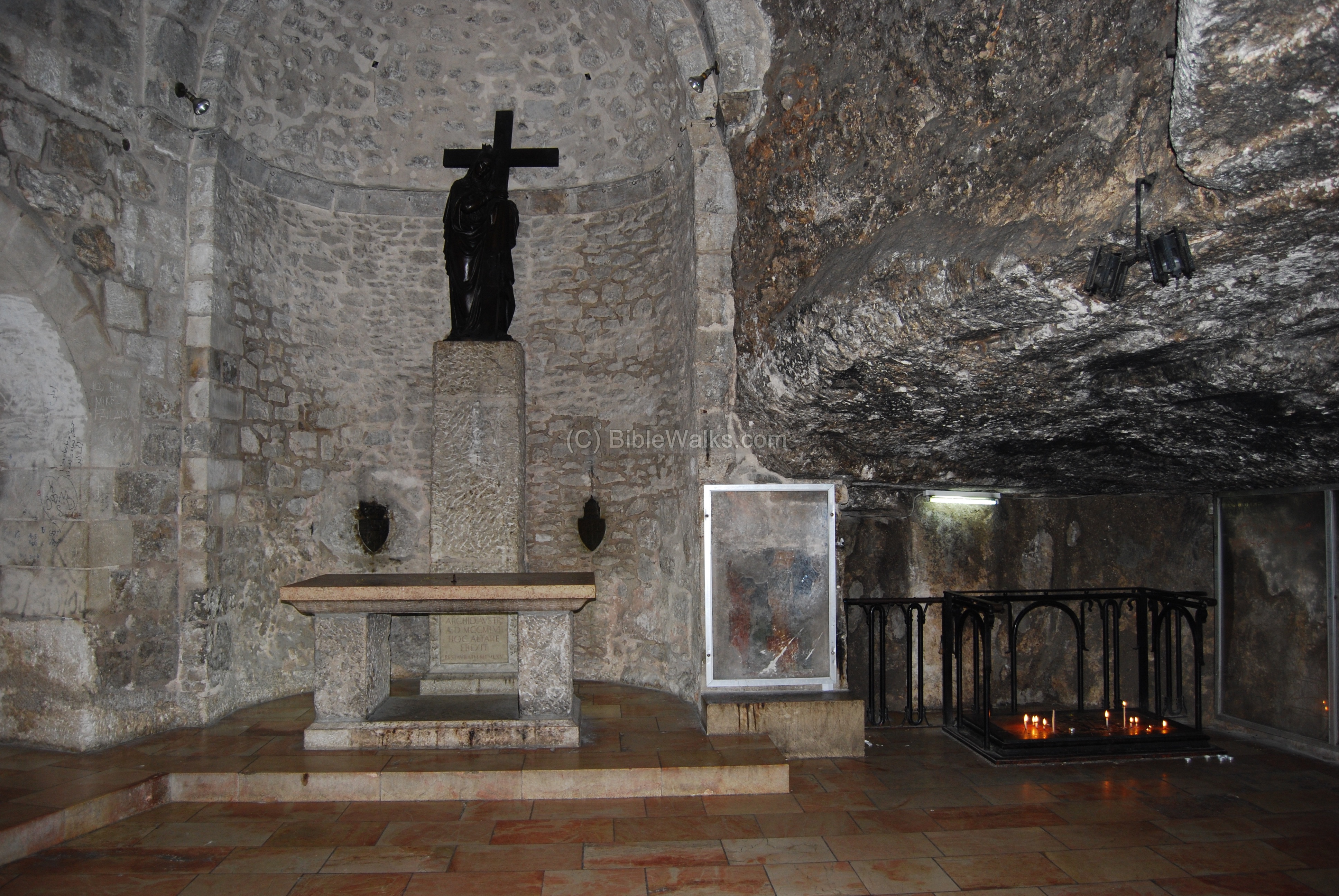
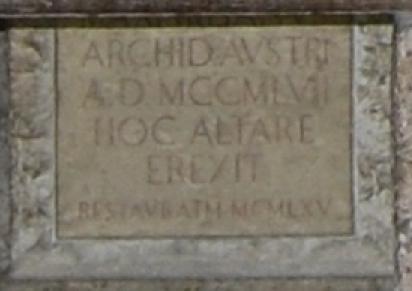
On the left side of the chapel (see photo above) is a statue of Helena, holding the cross. Under it is an altar with the inscription seen on the right side. It was donated by the Austral-Hungarian Prince Maximilian, which later became the King of Mexico. This was erected in 1857 and restored in 1965.
The remains of the cross were relocated to Rome, and are on display in the “Holy Cross in Jerusalem” church (“Basilica di Santa Croce in Gerusalemme”).
(q) Greek – Derision chapel:
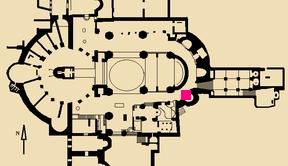
On the eastern side of the Church is the Greek chapel of the Derision.
See plan of the church; the location is marked by a red marker on the eastern side of the church, near the steps to the underground level.
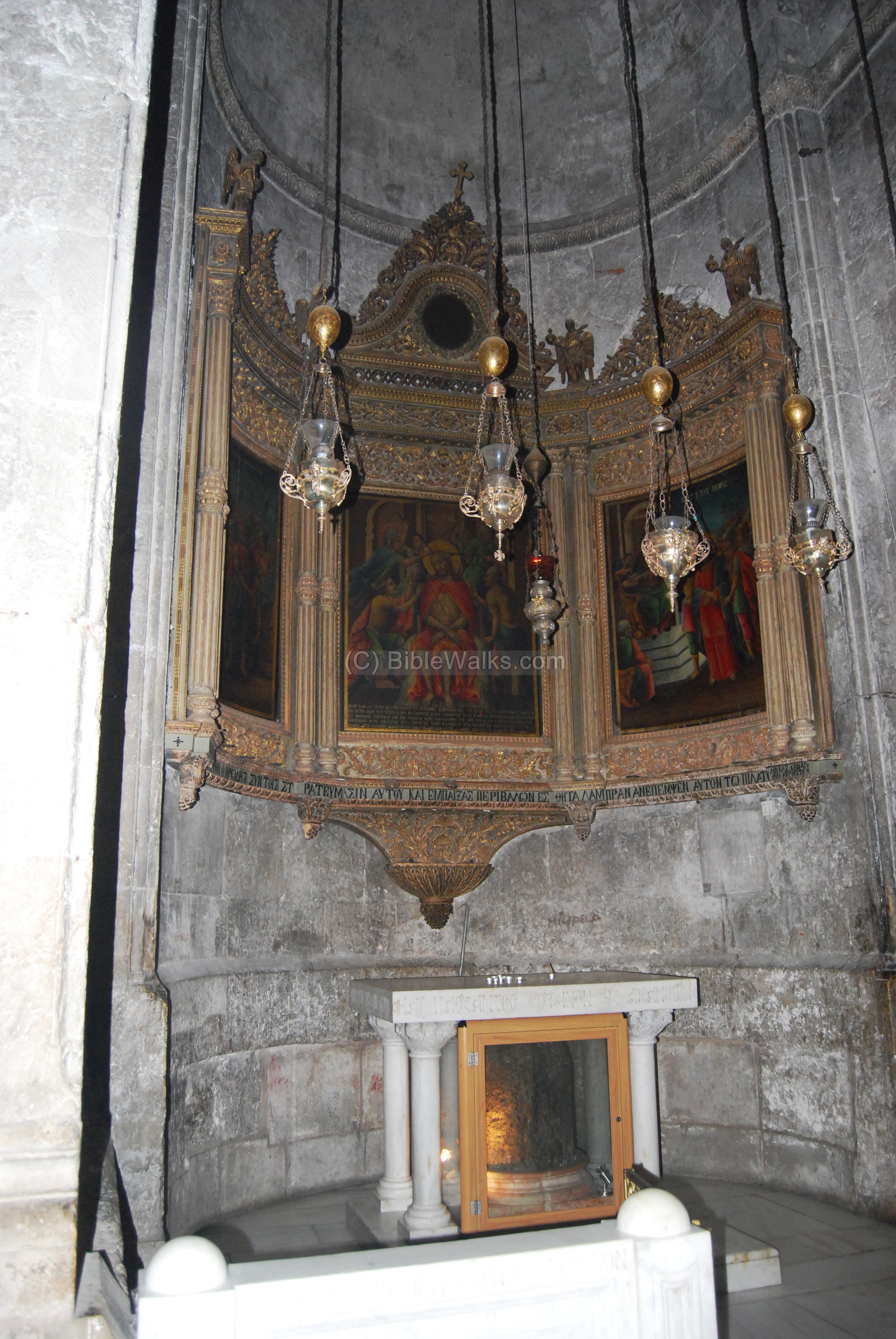
Derision, meaning treating with contempt, memorizes how the mob derided Jesus by mocking and laughing at him.
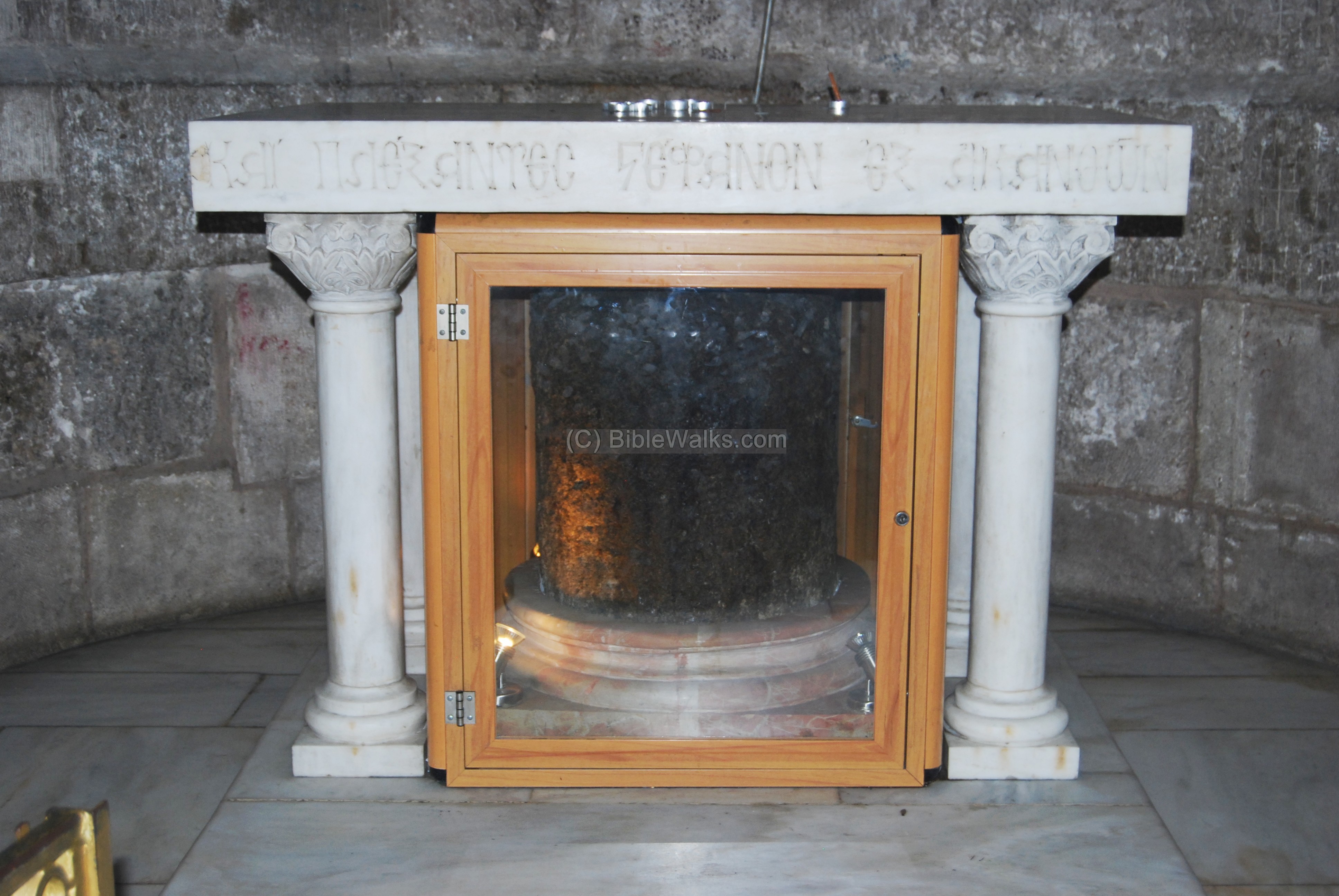
Under the altar, within a glass box, is a section of a stone column. According to tradition, Jesus was tied up to the pole.
(r) Chapel of Adam:
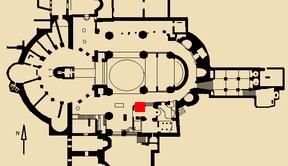
Under the Calvary, on the first floor near the stone of Unction, is a small Greek Orthodox altar in the “Chapel of Adam”. According to tradition, the the burial site of the first man was at the site of the crucifixion.
The plan of the church, with the location of the chapel marked by a red marker – in a small niche below the Greek Orthodox Calvary.
The chapel of Adam, the first man, is seen below. Inside the altar, on its eastern side, is the Golgotha rock behind a window. A crack in the rock is, according to tradition, the result of an earthquake caused during the crucifixion. This is according to the Bible (Matthew 27, 51): “Jesus, when he had cried again… and the earth did quake, and the rocks rent”. This crack is also seen on the floor above the chapel.

(s) Greek Orthodox Calvary:
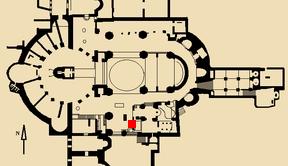
On the south side of the church, near the entrance, is a stairway leading to Golgotha, the traditional site of crucifixion.
The plan of the church, with the location of the steps marked by a red marker near the entrance to the church.
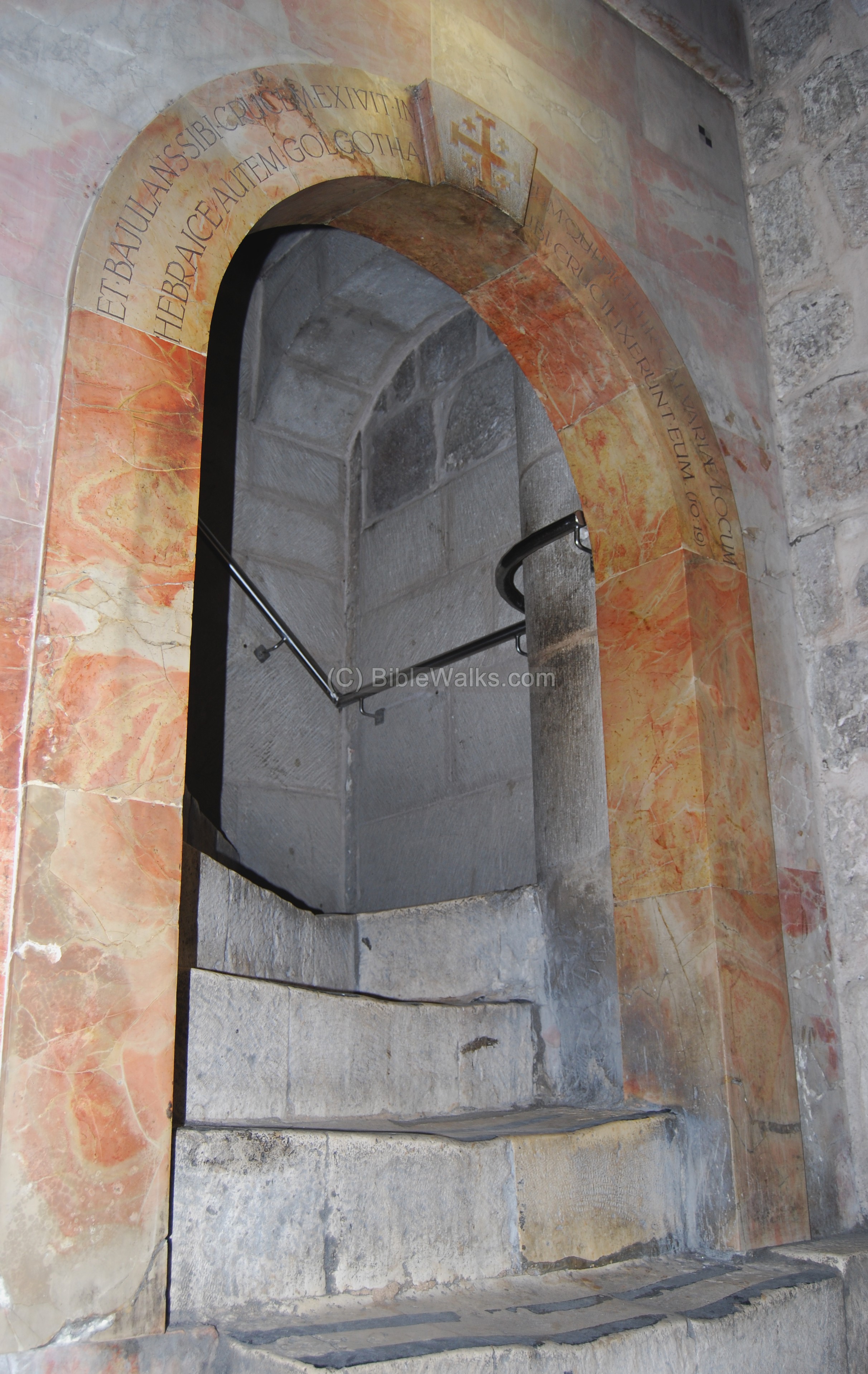
The steps lead to Golgotha on the second floor. There are two chapels on this side of the floor – the Crucifixion altar (Greek Orthodox Calvary) and the Nails of the Cross Altar.
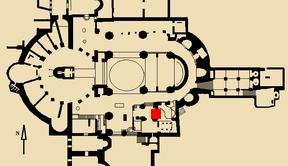
The plan of the church is here, with the location of the Greek Orthodox Calvary marked by a red marker on the second floor.
The Greek Orthodox Calvary (place of skull – Golgotha), seen below. According to tradition, Jesus is crucified here on the rock of Golgotha and dies on the cross. It is also marked as station 12 in the way of the grief (Via Dolorosa).
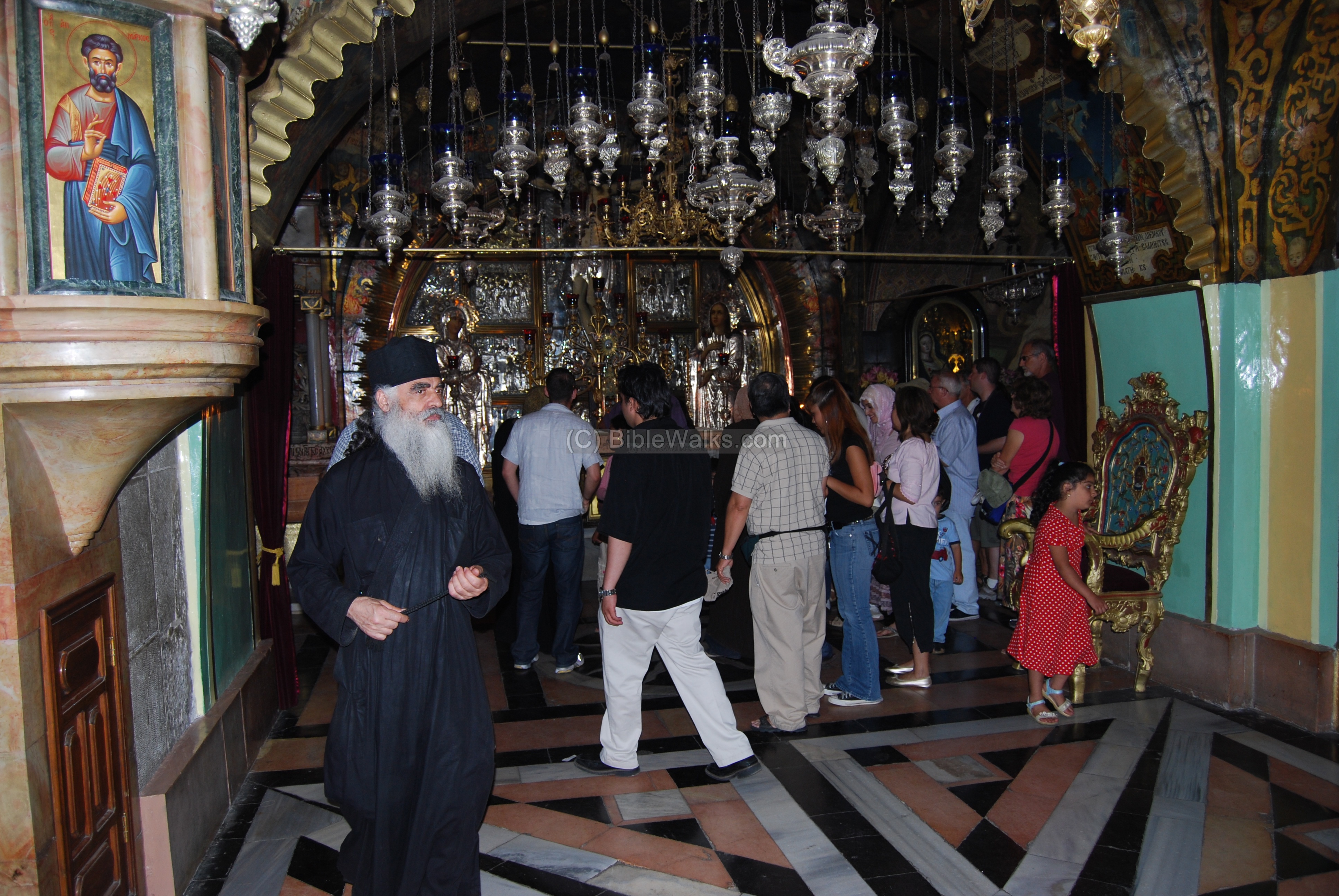
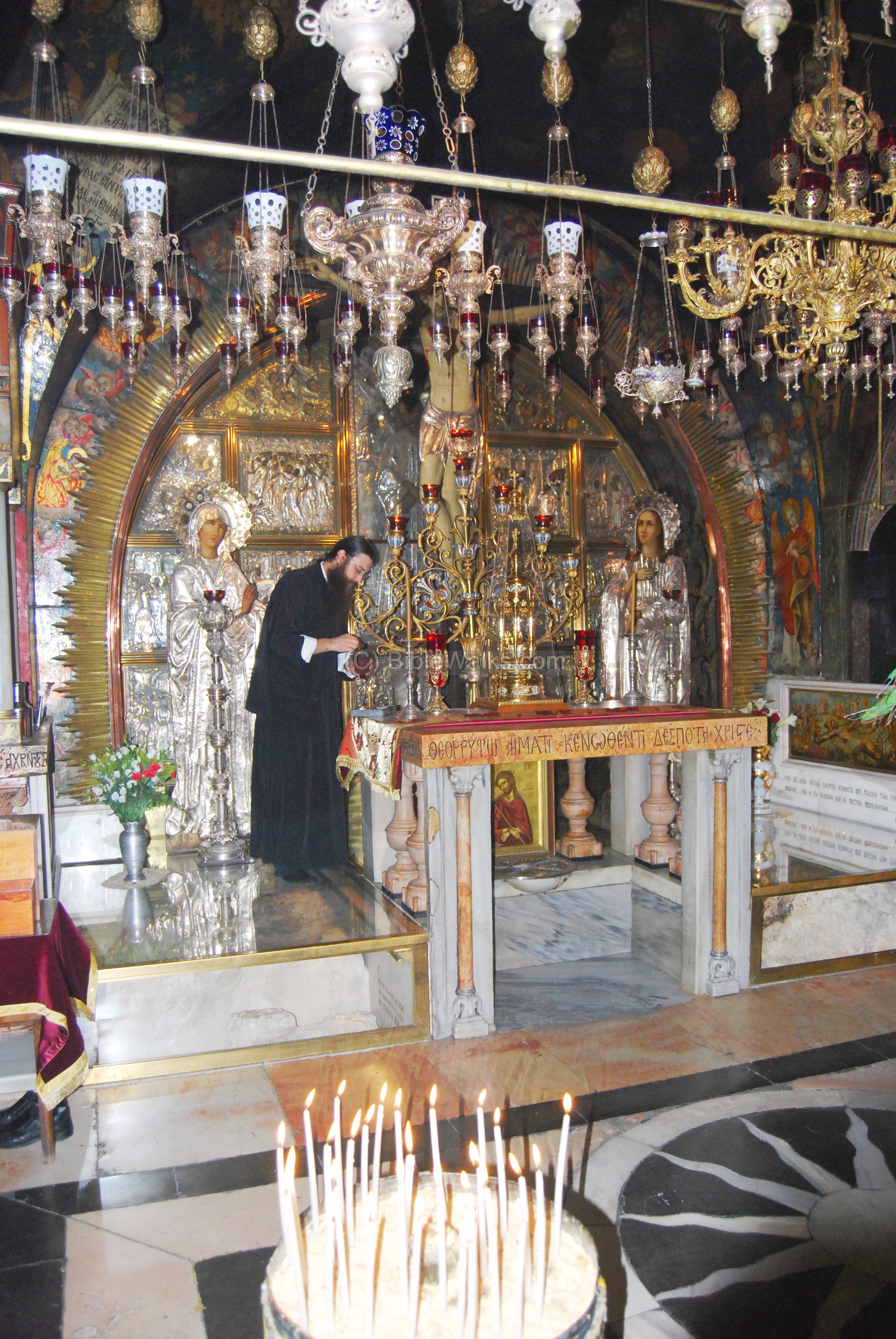
The Greek Orthodox crucifixion altar places the exact site of the crucifixion. A silver disk with a central hole, underneath the altar, marks the spot on the rock where the cross stood; pilgrims kneel and kiss the spot, as seen below. The silver icons of Virgin Mary and St John are on Jesus side.
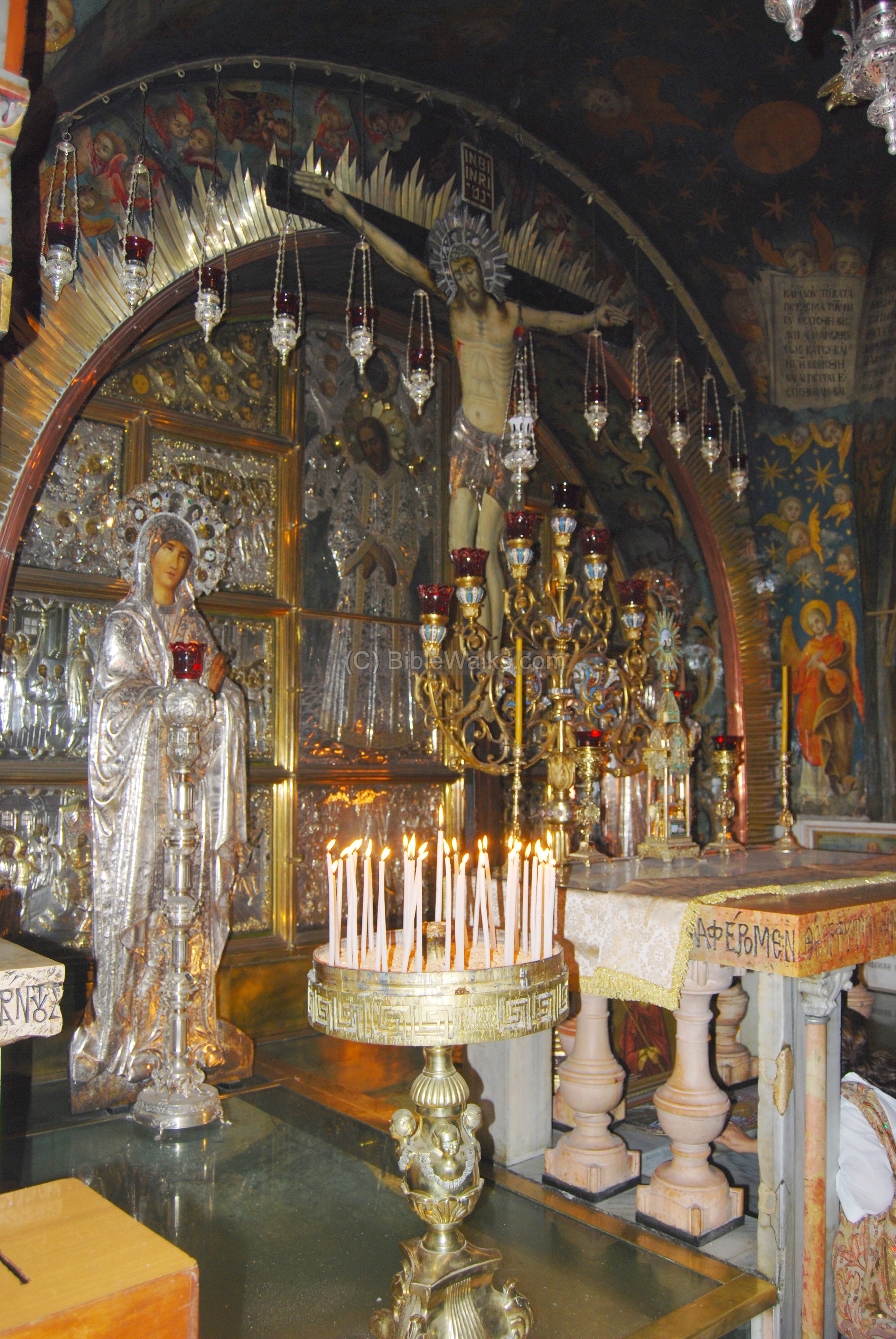
Another view of the altar is seen below. On each side of the altar is a black marble disk that show the position of the crosses of the two thieves that were crucified with Jesus.
The rich colors, glittering silver and golden lamps – create a unique atmosphere and cast a special Holy sensation – a common theme in all Greek Orthodox churches.
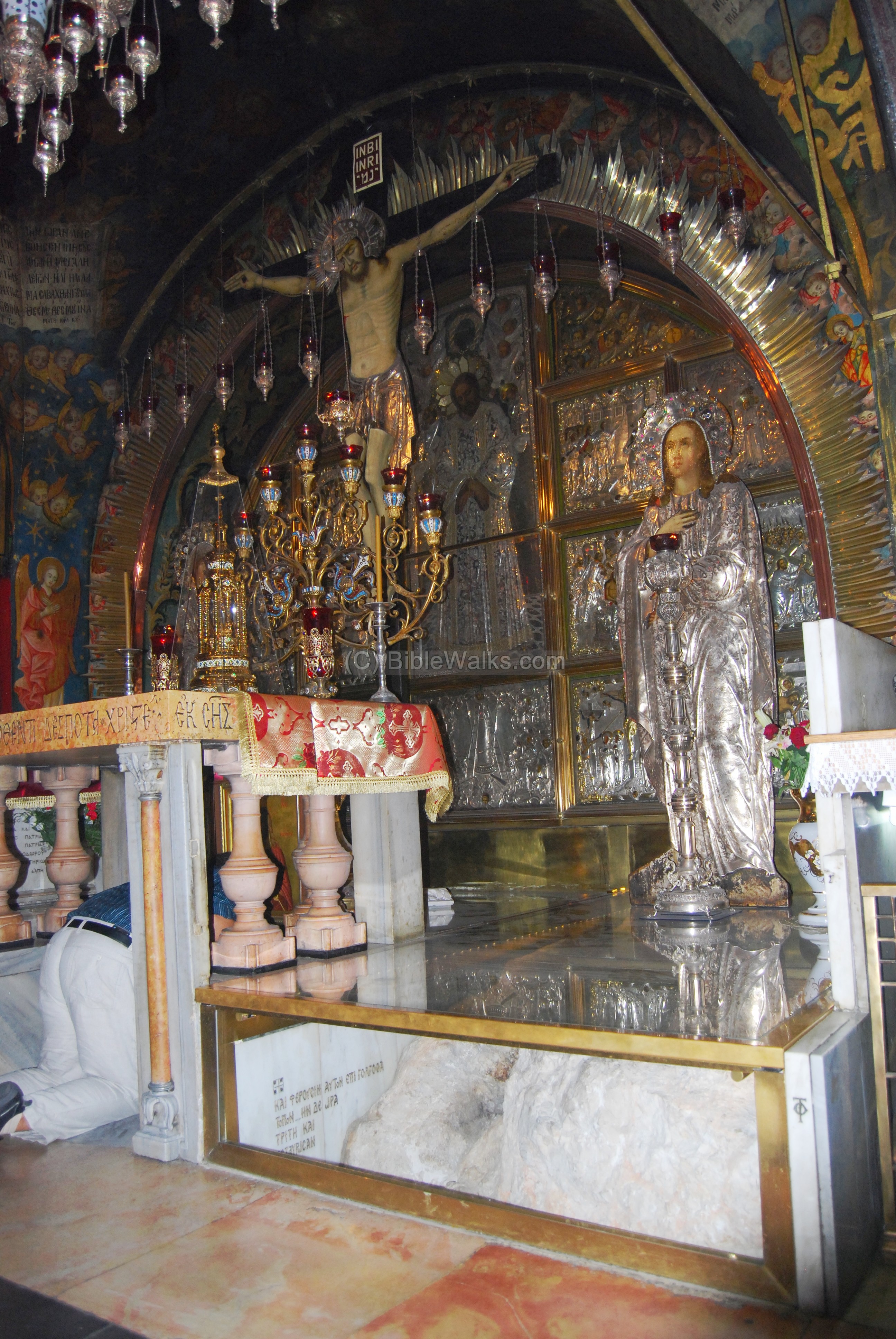
Another photo of the altar is seen below with the rock of Golgotha behind the glass. The crack in the rock continues down to the chapel of Adam on the lower floor, and according to tradition the blood of Jesus dripped down the crack to the skull of Adam.
(t) Latin – Nails of the Cross:
The Latin (Franciscan) altar on Golgotha is called the “Nails of the Cross Altar”, and is adjacent to the Greek-Orthodox chapel. Here, according to tradition, Jesus was nailed to the cross.
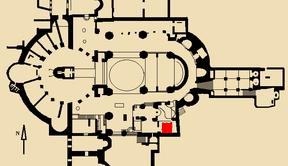
The plan of the church is seen here, with the location of the Latin altar marked by a red marker on the south-east side of the second floor.
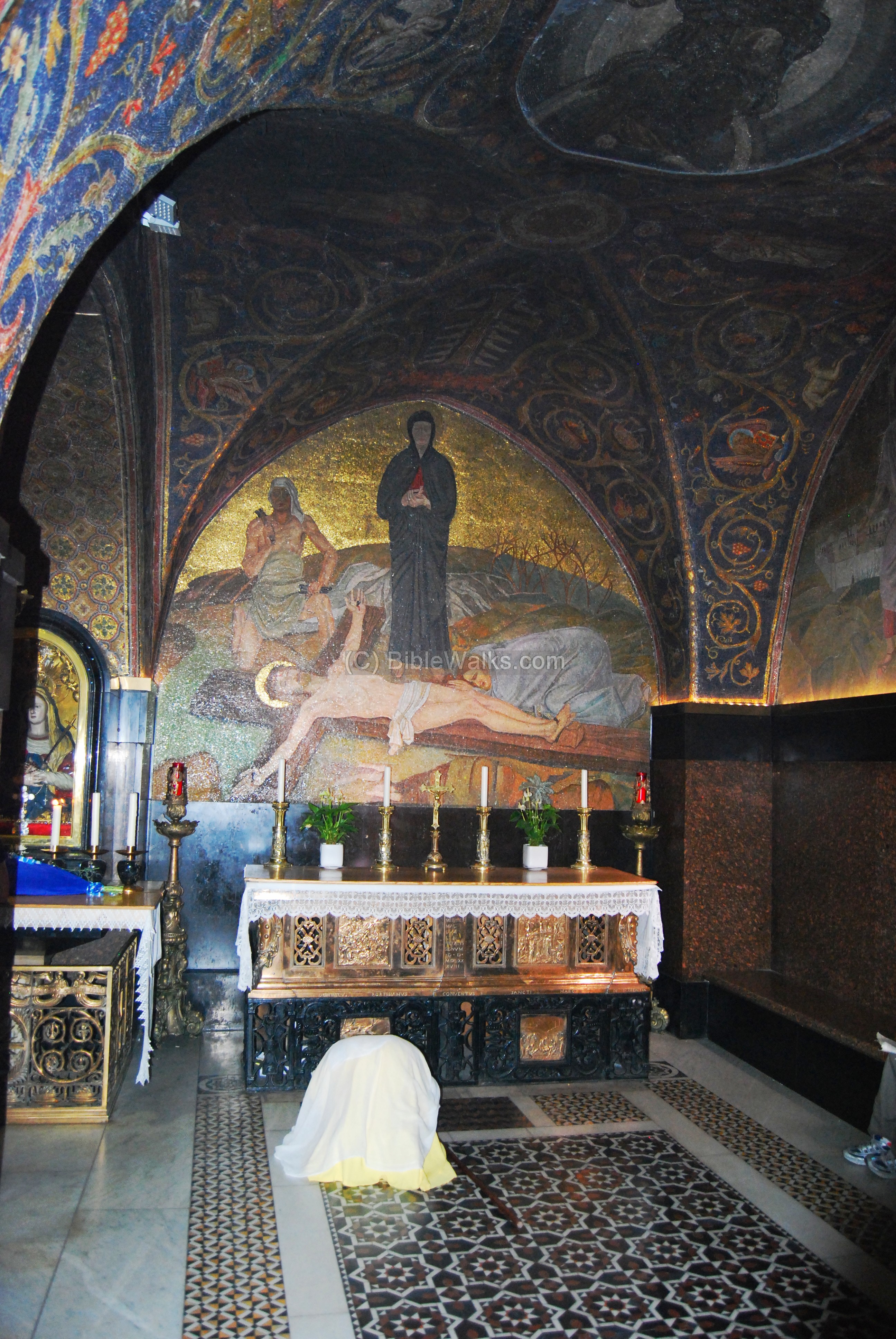
The altar is marked as station 11 on Via Dolorosa, and is located just behind the wall of the 10th station (Chapel of the Franks). The mosaics on the ceiling preserved a 12th century mosaic figure of Jesus. The more modern mosaics above the altar illustrate the crucifixion, the holy women at the foot of the cross, and the sacrifice of Isaac. This nave was constructed and designed in 1937 by Antonio Barluzzi, the famous Italian church architect who built many Franciscans churches in the Holy Land.
Biblical references :
These references describe the site of crucifixion and burial of Jesus.
Matthew 27:33, 35, 59-60
“And when they were come unto a place called Golgotha, that is to say, a place of a skull”…
“And they crucified him”….
“And when Joseph had taken the body, he wrapped it in a clean linen cloth, And laid it in his own new tomb, which he had hewn out in the rock: and he rolled a great stone to the door of the sepulchre, and departed”.
Mark 15:22, 46
“And they bring him unto the place Golgotha, which is, being interpreted, The place of a skull.”
…
“And he bought fine linen, and took him down, and wrapped him in the linen, and laid him in a sepulchre which was hewn out of a rock, and rolled a stone unto the door of the sepulchre.”
Luke 23: 33, 53
In Luke the name is Calvary (from Roman, meaning also place of skull):
“And when they were come to the place, which is called Calvary, there they crucified him,…”
…
“And he took it down, and wrapped it in linen, and laid it in a sepulchre that was hewn in stone, wherein never man before was laid”.
John 19:17, 40-41
“And he bearing his cross went forth into a place called the place of a skull, which is called in the Hebrew Golgotha”.
“Then took they the body of Jesus, and wound it in linen clothes with the spices, as the manner of the Jews is to bury. Now in the place where he was crucified there was a garden; and in the garden a new sepulchre, wherein was never man yet laid”.
Scenes from the wall Mosaic above the entrance to the Church:
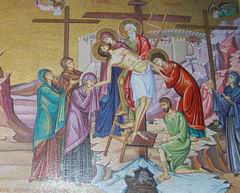
a: Jesus is taken down from the cross
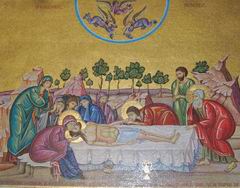
b: Laid down and wrapped in the linen

c: Laid into a new rock-hewn tomb
Etymology:
- Sepulchre/Sepulcher – burial vault. From Latin: Sepulchrum. Based on sepultus – to bury the dead.
- Golgotha – In Aramic , based on the Hebrew word: Golgoleth which is “skull”. Refers to a hill where the burial site of Jesus – the Church of Holy Sepulchre, in the Christian sector of the old city of Jerusalem. As in Matthew 27:33: “And when they were come unto a place called Golgotha, that is to say, a place of a skull”. The meaning of the name may be either due to the practice of burying the skull. It can also refer to a rock that looks like a skull.
- Calvary (Calvariae) – from Roman: place of skull. The name of the hill where Jesus was crucified and buried. Luke 23:33: “And when they were come to the place, which is called Calvary, there they crucified him…”
Links:
* External:
- Franciscans at the Holy Sepulchre
- Sanctuary Holy Sepulchre new web site
- Inside the Church – YouTube video by G. Kumaran (“When I recently visited the holy sepulcher I used the description in your website as a guide. You have put up a massive amount of information that is complete. Great work. It was really useful. Thank you so much putting that info. Eventually, I ended up making a video about the interior of sepulcher. I hope you will like it. “)
* Internal:
- jesus-walks. com – the pictorial presentation of the life of Jesus.
- Via Dolorosa – way of the grief – stations 9-14 are located around and inside the Holy Sepulcher
BibleWalks.com – walk with us through the sites of the Holy Land
Via Dolorosa<—previous Jerusalem site–<<< All Sites >>>—> Burnt House
This page was last updated on Feb 27, 2023 (new overview)
Sponsored links: